webby award What Works in Education

Syncing Up with the iKid: Connecting to the Twenty-First-Century Student

Educators must work to understand and motivate a new kind of digital learner.

by Josh McHugh

Print Forward Share Comments(51) Comment RSS
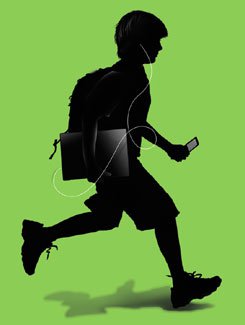
iKid
Credit: David Julian

Nathaniel Hawthorne's novels are pretty daunting fodder for the average English class, no matter how they're approached. But Diane Hamstra, a teacher at Park Tudor School, in Indianapolis, found a way to get her tenth-grade students to dive enthusiastically into the nineteenth-century moralist's dark thicket of language.

Hamstra used a software application called DyKnow Vision to let her students analyze various passages from the books on computer screens at their desk. She then posted their work on a large-screen monitor at the front of the classroom (the computer lab, in this case), and the students discussed the displayed examples. Hamstra has also had students analyze similar passages using pen and paper.

The difference is startling. Using the software, the students' responses "were deeper than with pen and ink," Hamstra says. "The focus was really sharp. There's something about changing over to an electronic medium, something about that screen. It's psychological. It's a generational thing."

No kidding. Teachers in every strata of education are increasingly dealing with a student population that is not only more wired than they are but also grew up in a techno-drenched atmosphere that has trained them to absorb and process information in fundamentally different ways. This generation of students is more likely to be armed with cell phones, laptops, and iPods than with spiral notebooks and No. 2 pencils.

Teachers who once struggled for students' attention mainly against daydreams, passed notes, class clowns, and cross-aisle flirting now also face a formidable array of gadgets and digitized content. Smart schools -- and smart educators -- are scrambling to figure out how to use these same tools and information-distribution techniques to reach and excite young minds. "You have to work with the kind of brains we've got now," says Susan Blackmore, who holds a PhD in psychology from Oxford University and frequently writes and lectures on new technology's effects on consciousness.

According to Blackmore, today's brains are shaped by various information streams -- sometimes referred to as memes -- constantly popping and sparking and competing for attention. This new generation of digital learners -- call them the MEdia Generation -- take in the world via the filter of computing devices: the cellular phones, handheld gaming devices, PDAs, and laptops they take everywhere, plus the computers, TVs, and game consoles at home. A survey by the Henry J. Kaiser Family Foundation found that young people (ages 8-18) mainline electronic media for more than six hours a day, on average. Interestingly, many are multitasking -- listening to music while surfing the Web or instant-messaging friends while playing a video game.

Educators must figure out how to compete with this frenetic memestorm coming at them from marketers and other students. Many are. The last few years have seen a rapid classwide and districtwide use of collaborative course-management systems such as DyKnow as well as so-called social technologies -- blogs, wikis, and media-syndication systems based on the Really Simple Syndication (RSS) protocol -- that allow anyone to shift from consuming media to being a media creator. Giving students powerful media-authoring tools means relinquishing a degree of control, but doing so also makes it possible to help them learn in more effective ways (and tighter time frames) than ever before.

One way of competing with electronic distractions is to optimize lessons for the MEdia Generation's rapid-fire meme-hopping tendencies. Leapfrog Enterprises, maker of the LeapPad Learning System, the talking-book device that topped the list of best-selling toys in the United States for several years, imposes a seven-second rule on the writers and designers of its teaching toys: Stories and lessons must progress in increments of seven seconds or less, at the end of which the book prompts the child to interact with it. A concession to a fragmented attention span, perhaps, but one that recognizes reality.

Collaborative learning, too, has taken a tech-driven leap forward. In the Cranbrook Schools, in Cranbook, Michigan, for instance, students use Moodle, an open source course-management system designed to create online communities. With it, users discuss class content with teachers and other students, take quizzes and tests, and get help after school.

Class Action

Although tech awareness in the schools has increased, in many instances it does not focus on the classroom. A recent survey by CDW Corporation shows that teachers are more likely to use technology to ease the administrative requirements of K-12 education than to utilize it in instructional applications. More than 85 percent of respondents in CDW's Teachers Talk Tech survey say that while they are adequately trained on Internet, word processing, and email software, 27 percent have little or no training with integrating computers into lessons. Nonetheless, the survey indicates that more than 70 percent of teachers at all grade levels believe computers are an important driver of student learning.

Christopher Moersch, an independent Internet-technology consultant who helps schools incorporate tech into the class, says most teachers he encounters are eager to engage their students with classroom technology, but federal testing requirements consistently get priority over technology initiatives. Consequently, teachers spend most of the day in drill-and-practice mode, preparing for standardized tests.

"The typical kid's reaction is, 'I'm bored to tears,'" says Moersch. "'There's a total disconnect between my life and what's going on in the classroom.'" But if that changes, the effect on learning could be immediate and widespread. More than half the students in a nationwide survey by the National Governors' Association said their classwork is easy, and two-thirds reported they would work harder if their coursework were more interesting or challenging.

Syncing Up

Click to enlarge picture

Credit: Henry J. Kaiser Family Foundation study, March 2005

Click to enlarge picture

Credit: Henry J. Kaiser Family Foundation study, March 2005

To some degree, our gizmo-intensive state of affairs is Alan Kay's fault. Kay earned the sobriquet "father of the personal computer" for his work at Xerox PARC (Palo Alto Research Center) in the 1970s, where he came up with the concepts of the personal computer and the graphical user interface. But originally, Kay wasn't trying to create a better tool for business. He was thinking more along the lines of a teaching machine. In 1968, Kay, a computer science graduate student at the University of Utah, heard that Seymour Papert, an artificial intelligence researcher at the Massachusetts Institute of Technology, was doing interesting work with computers and kids, and he visited Papert in Cambridge to check it out.

Papert, working with pioneering educational psychologist Jean Piaget, came up with a programming language called Logo, simple enough for kids to use to do math, generate poems, and even translate sentences into Pig Latin. The theory behind Logo was that children, by actually creating their own learning environment, would retain far more knowledge than they would from ordinary teaching methods. Kay came away from his visit with Papert with several new ideas, one of which led to object-oriented computing and another that prompted a device called KiddieKomp, later renamed the Dynabook.

In a 1971 memo, Kay described his vision for the device, originally intended specifically for children to use as a learning machine: "In the 1990s, there will be millions of personal computers. They will be the size of notebooks today, have high-resolution, flat-screen displays, weigh less than 10 pounds. . . . Let's call them Dynabooks."

And so it came to pass, almost exactly as Kay predicted/invented it. Except for one thing: The problem, Kay told me in a recent email, is largely with "the difficulty of adults to adjust to new ideas. I don't mean really new ideas like computing, but ideas new to the human race, like science and how it uses mathematics, or even slightly older ideas like reading and writing. Teaching the latter is still a struggle, despite its relative antiquity (and despite the fact that we know very well how to do it best). And real mathematics and real science are not yet taught in elementary and even most high schools."

Turning of the Tide

The slack tide of educational innovation Kay laments is beginning to turn, as teachers deploy the latest wave of teaching technology. The kind of Dynabook Kay envisioned is still in the wish list stage, but the means to deliver the deeply educational Dynabook experience Kay had hoped for are all around us: laptops, handheld computers, powerful cell phones, the same inescapable computing devices frequently bemoaned as weapons of mass distraction.

Together, blogs, wikis, and other social technologies are seen as a new entity that goes by many titles -- the semantic Web, Web 2.0, the read-write Web -- but whatever you call it, this swirl of media may well end up doing Kay's vision one better.

Pamela, a student at North Whiteville Academy, an alternative school in North Whiteville, North Carolina, writes on her page of teacher John Blake's class wiki, "Students are learning how to micromanage an array of elements while simultaneously balancing short- and long-term goals." Pamela's observation, incidentally, is at the heart of the defense of video games advanced recently in Steven Johnson's controversial book Everything Bad Is Good For You.

QUOTE

"Kids are bombarded by media," says Blake. "They're completely high tech, and they don't know a different way. When you hand them a book, they're going to say, 'Is this all there is?'"

Looking for more structure and access control than the wiki system gave him, Blake switched over to Moodle software this fall to manage class-related conversations, homework assignments, and quizzes. He also encourages students to keep blogs using BlogMeister, a student/teacher system created by the Landmark Project. To tie it all together, Blake's classes use Bloglines, a Web-based tool that aggregates RSS feeds generated by Moodle and BlogMeister so all the school-related activity and conversation can be viewed in one place.

"This is a mix-and-match generation," Blake says. "I'm looking at these things as a way to hook into what they're doing outside the classroom. When they see that I know how to use the technology, they think, 'This is going to be cool.'"

At Martin Luther King Elementary School, in Atlantic City, New Jersey, fifth- and sixth-grade classes made short documentaries about local history, architecture, and celebrities and post them to the school's video blog, Atlantic City Rough Cuts. "We're using video blogging to put students in contact with real professionals," Art Wolinsky, the consultant and retired teacher who helped set up the Atlantic City project, said at the time. "They're-creating products that are going to have an impact on them, on their friends, and on the community."

Older kids, even those getting ready for college, benefit from new applications of technology. High schoolers can tap into Boston Test Prep's BTP to Go, an audible SAT test-preparation course downloadable onto digital audio players such as iPods, as well as PDAs, smart phones, and other listening devices. The audio format allows students the freedom to prepare for the SAT at their own pace and within their crazy schedules. Such personalized instruction can also alleviate much of the stress caused by an SAT prep course held in a traditional classroom setting.

Shifting Power Centers

Of course, there's a price educators pay when they open their classes up to the world: Power tends to move from the center outward, an exact duplication of the effect of the Internet on many institutions. In March, the principal of Proctor High School, in Rutland, Vermont, banned access from school computers to MySpace, a blogging site popular with students, saying blogging isn't an "educational use of computers" and citing concerns about Internet predators.

Just as in corporate America, where companies such as Delta Airlines, Microsoft, and even Google have fired employees over blog posts, schools are working on policies designed to protect themselves while trying not to stifle personal expression. For educators accustomed to making and enforcing absolute rules, letting the inmates take part in running the asylum (an inexact metaphor, of course) is going to take some getting used to. But in the end, the best way for students to learn about the world they live in is to have a hand in creating it.

"The key to teaching is keeping kids involved," says Ryan Ritz, the computer science teacher who first brought the DyKnow system to the Park Tudor School. "They like everything being electronic -- it's speaking their language." Ritz cites near-instant feedback during class as the most important feature of the system, allowing him to know which points the students have observed and which ones need to be revisited." You know immediately where they stand," he says. "This is a better way to learn."

Josh McHugh is a contributing writer for Wired magazine.

This article was also published in the October 2005 issue of Edutopia magazine.

Advertisement

Comments & Responses


Teaching Art with Technology

There is no doubt that today’s educator needs to stay on top of technological trends in order to engage and motivate our students who are all tech savvy. However, with the current budget crisis that many school districts face, it is going to be quite a challenge for educators to be trained and current software and updated technology to be purchased. Teachers will have to be creative in accessing free online resources, collaborating with colleagues who perhaps are more on the cutting edge with technology and allowing our students to lead us into the changes of the digital age. All this being said, we must not forget that teaching is about content, not gadgets.

I am a high school art teacher who teaches an introduction to art using the computer as the main medium of expression This course, Studio in Media Arts, fulfills the New York State requirements for an art credit for graduation. I designed this curriculum since I felt that there was a need to engage students in the arts, be it traditional art or digital art, in a way that they can relate to. This has become such a popular class that it another teacher now has to also help teach some of the sessions.

Although we use computers, the students are taught art. I stress that the class is not a technology course nor am I a technology teacher. The computer is used as a vehicle to help the students explore their creativity and learn about art history in a fun way that is relevant to them. They learn about the elements and principles of art and can apply this same thinking to a painting or sculpture, as well as, the computer. I always encourage students to also take classes in traditional art. The arts, in any form, can engage students in creativity, over all education, and help to develop the critical thinking problem solving skills that they will need in this ever-changing world.


Importance of Technology in the Classroom

This article was very interesting. There are still many teachers out there who feel that the old pen and pencil way is still just fine. Obviously studies are now showing and proving that is not always true. We need to change with the times. As teachers we should be modifying year after year anyway to best meet the needs of our students. Technology is a huge part of that. I myself, in my eighth year, get overwhelmed with that idea because staff development and time doesn't always allow for it. However, if we did even a little at a time to incorporate these new ideas, it would make a difference.
We are in a huge technological time and as the article states, some student's minds work a little different now. We must adjust. This would definitely help with the boredom and disconnect some kids are feeling at school.
I went to a class on wikis this year. I had no idea what on earth the guy was even talking about at first, but it seemed quite interesting and would be something I would be interested in learning more about. He had his students do homework that way and respond to each other etc.
As a science teacher, I am thinking how useful something like that would be in regards to articles and such about all the research, cloning, stem cells, DNA information etc there is out there. They could have debates, discussions, voice their opinions and concerns. I think that would be great.


I am a first grade teacher

I am a first grade teacher and I absolutely agree that children are powering down when they come to school. Technology plays such a crucial in their lives. Recently, I taught a unit on maps. While charting what my class already knew about maps, I realized that many of them would never have to open up a map in their cars that would fill up the front seat. Almost every child had some sort of GPS device in their car. I knew that I had to approach this unit of study differently. I think it is important for teachers to learn as much about technology as possible and I think that districts need to be more responsible about providing learning opportunities. There is a lot of inconsistency in schools. There are the teachers that are tech savvy and those that are not. I believe that districts need to even out the playing field so students have common experiences.


Connecting with the 21st Century Student

As a teacher, it is my responsibility to try a variety of ways to connect with my students. While there continues to be much value in "tried-and-true" methods, I feel I must educate myself in the rapid-fire world of technology. Yes, kids today are assaulted by media, but they are adapting and multi-tasking successfully. For me, I've always maintained a healthy skepticism, yet seeing is believing. This year I had a Smartboard in my classroom for the first time, and it clearly maintained student interest longer. Now I am compelled to familiarize myself with other forms of technology, because that's what the 21st century requires.
Still, I worry that the hardware or software will change as soon as I feel proficient in it. How am I to keep up? My brain is not wired in the same way as today's learners; my skills are improving, but it's likely that my students will always be more skilled. My school district boasts a strong technology department, and specialists try to keep us updated on many of the new products. Without them, I would be lost.
I don't agree that technology can replace the joy of reading a good book, turning its pages, folding down corners, jotting notes by stirring passages, rereading favorite parts. However, perhaps technology can help the reluctant reader through different interactive methods. Yet, as the teacher, I have the responsibility to try connecting with my students in whatever ways work best for them.


Bend Like a Bamboo

I know teachers who think that technology is just another one of those gimmicks in the classroom. A gimmick that might be the buzzword right now, but can very well change in a couple of years or so. Hence, they don't bother to incorporate the Smartboard that they were lucky enough to get in the classroom into their lessons. Like the article mentioned, they use it for "administrative tasks" like taking attendance, for example. Others, meanwhile, don't like technology because they think it dilutes their content. What this article clearly shows us is that technology can enhance the content that we teach. With the various sources out there, students can bring in their own knowledge when covering a topic in class. And I think therein lies the problem for some of these anti-tech teachers -- that the kids may know more than them. The article also made a valid point of how the Internet had shifted the power from the center. This ultimately will happen in the classroom. Once the only repository and deliverer of knowledge, now the teacher or professor may be threatened. But that is exactly the gate of opportunity that educators must use. We SHOULD empower students with their learning. My personal motto in the classroom is that we teachers are here not only to teach them the WHAT of learning, but more importantly the HOW of learning. How do we take in and disseminate information? What's the best way that I learn? And with today's technology, we've got to capitalize on their knowledge. If it's technology that will get them to pay attention or apply the content, then that's the avenue we need to take. We must be like a bamboo -- sway with the wind, but still keeping all its strength in tact. We are not selling out if we use technology; we're enhancing their experience and ours.


I teach a class of Autistic

I teach a class of Autistic children who range in both age and ability. In my classroom and I’m sure in many other classrooms motivating students and keeping their attention are two of the top five challenges! Although many people feel that our ability as educators to guide students is ‘old school’ and technology is a more efficient way, I feel technology is a ‘good buddy’ and should be supplemental. Technology is fascinating and it certainly opens a window to ‘their world’ but I believe students, especially Autistic students need the human connection and interaction while learning how to respond appropriately to people. I recently received a Smartboard in my classroom and it has been an amazing tool in gaining student attention and increasing participation. At first, I thought this was going to ‘save me some energy’ and I quickly learned that the Smartboard is a tool to enhance teaching rather than an ‘energy saver’. A few ‘cool tricks’ technology has brought to my classroom through the Smartboard is…animation, amazing visual aides and the touch of a finger to change the screen and regain wandering minds. Technology is a gift to the classroom!


Create a Level Playing Field

In my opinion, rather than fighting technology, I feel that we need to embrace it. There are so many uses for technology that will help us to further students' learning and reach students who we might otherwise not reach. I have two children of my own who are much more tech savvy than I. My older son, has struggled with OT issues, especially handwriting, and my younger son, who has autism and has obviously struggled with more than OT issues, both florish when able to use a computer. Last year I received a grant to purchase books on CD. I was able to correlate the books that I purchased with books used by each grade level in my building. In this way, children who otherwide would struggle to decode some of the text, were able to hear the words read fluently and they were provided with a model of good oral reading. I purchased all of the audiobooks through Amazon, where I could get the most bang for my buck. While searching for books, I came across information about Kindle, an electronic device for downloading books. They call it "wireless reading", and I couldn't help but notice the huge difference in price for downloading a book, which was very cheap, and buying CDs which could cost as much aa thirty or forty dollars each. The Kindle, or other wireless reading devices, will certainly be the wave of the future. For example, it can holdmore than 1,500 titles and after purchasing a book, it is delivered to your Kindle in less than 60 seconds. This is an expensive device, about $350, but if that's too much for your current classroom budget, an alternative could be to download books to an i-pod and students would check out books and take home the i-pods with the audio on them. I am looking into applying for another grant next year, with which I could purchase i-pods for students to borrow for listening not only to audio books, but podcasts as well. I've given students website addresses so that they can practice certain skills at home, however, we cannot assume that the playing field is level for all of our students. I deal with students who have immigrated from other countries. Some of these students have every electronic device available to them, and others don't have the internet or a computer at home. So, as we expand our use of technolgoy in schools, we must keep the playing field equal for all students and make sure that they all have equal access to technology, regardless of income, which will certainly be a challenge.


The NEW Way!

Teachers do need to continue to educate themselves on all the new trends and ideas in education. Research has a way of changing things every few years. Change is hard but necessary for all. Our children are growing up in a media world. "The key to teaching is keeping kids involved," says Ryan Ritz, "They like everything being electronic -- it's speaking their language." Ritz cites. Ritz could not have stated it better. If keeping kids engaged and involved means changing how we teach then we must do so! Children get only one chance to learn so it is our job as teachers to give it our best shot. Teachers need to connect with what children are doing on the outside and bring those interests into the classroom. That is what makes learning fun and meaningful.
As a student, I often wondered why do I need to know this? Why are they teaching me this? How will I ever use this? Answering these questions is so important for children. It helps them connect the real world to the classroom.
For all those teachers who think they can continue to teach from the same binder year after year...STOP! Think! How can I ,make learning fun and engaging for all my students? The answer is through technology!


Technology: An important teaching tool

I have always believed that teachers are more then just educators. We can not expect to simply provide information to our students and expect them to absorb it like sponges. Our job description and has expanded to entertainer as well. I teach technology classes to middle school students in Massachusetts and have found that kids love just about anything that has to do with technology. My classes work on computer related assignments 90% of the time and the behavior issues are few. Students often tell me that my class is the one they look forward to each week. I do not have any special plan for success that the other teachers are missing; my weapon to combat boredom is the use of technology.

I tried to teach the concept of data bases to an eight grade class with limited success, there was little interest in the topic until I took out my cell phone and asked “who has one of these”. Head s immediately went up, eyes opened wide, and all hands were raised. They were now eager to hear what I had to say. I went on to explain that the numbers they have in their phone are a data base they created. In order for students to have an interest in the subject or topic being covered in class they need to see how it is relevant to their life. Discussing a random list of data is difficult to relate to, but the way their friends and families phone numbers are stored on a cell phone is an interesting topic they will want to explore further.

Do you want to create more interesting lessons? Have a more manageable classroom environment? Get the student’s attention and keep it by integrating technology into your classroom.


A agree with this article

A agree with this article that technology is becoming a huge part of education. I think it really is neat and will provide some students with a lot of extra support. I believe that if teachers are willing to go through the training to learn how to incorporate it into their classroom, they will be surprised and happy with the results. I admit that sometimes it is overwhelming, but I don't think it's going to go away. In fact, I believe it will become the norm. I am lucky enough to be a school district that is very supportive and in favor of using technology. All classrooms are equipped with wall projectors instead of tvs. It seems like everything runs though the computers! The 5th grades are wireless and can be found using laptops on a regular basis. The goals is to have this for every classroom. Our principal feels that in a few years, we will no longer even have a "computer lab" since we will have the laptops to use! I am excited to see how far technology will take us and to see the benefits that will be seen in the future.

Post new comment

Share your thoughts with others. Please increase the credibility of your post by including your name, school, grade level, and city, and by demonstrating respect for others' opinions. Comments will not appear immediately; all comments are moderated and will be posted in order of submission.

The content of this field is kept private and will not be shown publicly.
  • Allowed HTML tags: <a> <em> <strong> <cite> <code> <ul> <ol> <li> <dl> <dt> <dd>
  • Lines and paragraphs break automatically.

More information about formatting options