WHAT WORKS IN EDUCATION The George Lucas Educational Foundation

How to Engage Young Students in Historical Thinking

Last week over breakfast, my six-year-old son declared, "George Washington was a good president."

"Why do you say that?" I asked.
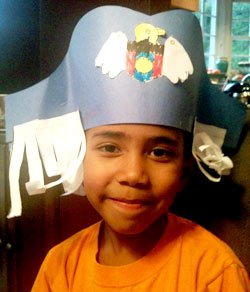
Boy with hat and white wig
Credit: Elena Aguilar

"Because he freed us from England," he said.

"Some people think he was good, others disagree," I said.

"My teacher thinks he was good," my kindergartner responded.

I then explained to my son that I thought he'd done some things that weren't fair. "George Washington owned slaves and one of the reasons he wanted to be free from England was because he wanted to be even richer than he already was," I told him.

My son had no comment and resumed eating his granola. We're pretty anti-slavery in our house, so I imagine he was contemplating that contradiction.

I controlled the tirade that threatened to erupt; I am quiet about my many pedagogical disagreements with my son's teacher. I'm making a big effort to embrace the public schools in the district that I've worked in for 15 years as I send my only child into its classrooms.

The Old Approach

My son's class has been learning about George Washington and Abraham Lincoln for over two weeks -- and the unit is not yet finished. They cut out construction paper faces of Washington and glued on cotton balls for wigs; they memorized lyrics to a song which stated that "Lincoln freed the slaves;" they stapled together paper hats "like the patriots wore" and listened to stories about Revolutionary War battles.
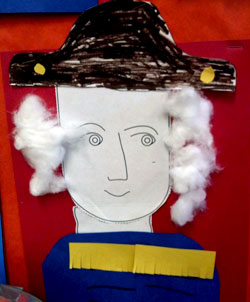
Art project of George Washington with construction paper and cotton balls
Credit: Elena Aguilar

The George Washington comment had me boiling for two reasons:

First, this is not the way to teach history. This approach -- an uncritical, history-as-true-fact, spoon-fed-hero-worshipping of rich white men and the unquestioned glorification of those who have always had power -- is not acceptable for my kid or any kid.

Secondly, I'm shocked by any teacher's lack of cultural competence. I can't imagine what one might think as they look at students' faces, such as those of my son's classmates (some of whom are African American or recent immigrants), and declare, "George Washington freed us from England." He sure didn't free my people who immigrated in the twentieth century, and he sure didn't free my husband's ancestors who were brought to this country in shackles.

Necessary Standards for Teaching History

In California history classes, along side the content standards, there is a set of standards for teaching historical analysis skills -- starting in kindergarten.

If our schools are going to be successful in preparing our young people to actively participate in a democracy then we need to go far beyond just teaching the content standards in history. Going deeper means this:

Students understand that history is a construction.
This means that students recognize that "there are no truths, only stories," as the Native American poet, Simon Ortiz, says. Students also understand that the history that has been written down is a story told by the victors, the conquerors, those with power who constitute a tiny segment of the population, and that it is a story told often to justify their own power.

Students know how to deconstruct history and re-write it.
This means that children learn how to be historians. They can analyze primary sources and develop their own interpretations. They can identify bias in other people's interpretations and consider how privilege and status impact the way events are recorded. They also look for and listen for stories that have not been told, and they see the value of bringing those stories to light.

Students know their own histories.
A kindergartner should be learning about his own family history before learning about George Washington. He should first learn about how the past affects the present, about the people he comes from, and about the struggles and accomplishments of his ancestors. Maybe such a sequence of instruction would result in more kids enjoying history -- in fact, that should be another standard.

Students enjoy studying history and recognize the value in doing so.
This means that students understand that in order for us to better our world, to fix some of the terrible injustices and perhaps even save our planet, they need to understand the past. They need to understand how we got to where we are and they need to recognize their own power to be able to change the situation. History is the ideal curriculum to allow this to happen, but only if students enjoy the material and see how it can be a tool for empowerment.

A New Approach

I have no problem with kindergartners being taught about George Washington, as long as they are being asked to think critically and consider multiple perspectives, and as long as they are also learning about other people.

Here's what I mean: A teacher could introduce the study of American presidents by reading a picture book that presented an alternate perspective on Washington, perhaps told from the point of view of one of Washington's three-hundred slaves. She could have students consider what makes a hero or what makes someone worthy of respect, asking them to evaluate Washington's actions.

Even when instructing our youngest students, we communicate beliefs and values about people and power. All teachers should be clear about what beliefs they are communicating and should question their appropriateness.

Here are a few resources to think through a framework for teaching history:

What is your philosophy for teaching history? What standards do you think should be added?

Comments (87)

Comment RSS
Parent of one middle school student

I understand the author's

Was this helpful?
0

I understand the author's frustration with one-sided history lessons, however going from one extreme to the other will not solve the problem. While I disagree with slavery and hero worship, it is vitally important to understand the context of these ideas. George Washington was a wealthy landowner who owned slaves. Most wealthy landowners owned slaves. Thomas Jefferson also owned slaves. Until technology could replace slave labor, slavery was essential to commerce. Slavery was a fact of life for thousands of years in many civilizations. The Pyramids were built with slave labor, yet they are still considered one of the Seven Wonders of the World.
George Washington was revered even in his own time. Before he was given the title President, some wanted to make him a king or emperor. If celebrating American history in America is offensive, where are we going as a country?

9-10 grades passionate History-Civics teacher

Thanks

Was this helpful?
+1

One nneds moderation. For these are times when the pedagogical approaches have undergone changes and the Child is not to be one who is receiving information/knowledge but discovering and making sense in every little word and act. I would think moderation and throwing open the probabilities should be the trend than colouring the opinions either way.

Special Education 9th-12th

I like your thoughts on

Was this helpful?
0

I like your thoughts on teaching alternative points of view in History. I think too many times we glorify certain historical figures and we don't teach students to look at both sides of the history of that person. A good example is Christopher Columbus in 5th grade standards. He is taught from his perspective in discovering America. However, the students are not required to learn the perspectives of the Native Americans whom he ultimately turned into slaves and raped and killed. The 5th graders do not have to learn about intricate details into this matter, but could definitely learn to look at history from different perspectives.

Are you serious?

Was this helpful?
+1

They are in kindergarten. The creation of historical thinking is well beyond their age. And for AMERICAN HISTORY George Washington was a hero. So what if he owned slaves, most people did. Just because it is seen as bad in the current age doesn't make it wrong back in the 1700s. Slaves have been around since the beginning of history. The problem people have is they focus on the blacks who were slaves. Oh my!!! Africans, Asians, Europeans, and Muslims have ALL had populations enslaved. So, are we to condemn the people who fought to create a free America because they owned slaves? What about the black people who owned slaves? What about the people in Africa who enslaved their own people? What about the people in Africa who cause mass genocide of their own people? The problem is we are teaching about the poor black slaves in America and how they were mistreated. What about the poor slaves who built the Great Wall of China and were buried under it when they died? When does that get taught to children? Oh wait, I will agree with you. George Washington wasn't a hero. He was a man committed TREASON against his country so you could have breakfast with your child and say he was a "bad" man because he owned "slaves."

Thanks Lance

Was this helpful?
+1

Finally another good comment. For more historical factual information talk with the members of the Frederic Douglas Foundation. I recently saw two members of this Foundation on You Tube. WOW! Go to You Tube - search for July 4, 2010 Amy Reid and July 31, 2010 Vanessa Jean Louis. Sunlight cleanses! Thanks Ladies great job - awesome inspirational speeches too. "Lies My Teacher Told Me", really educators? Please go to a great source like The Frederick Douglas Foundation for facts! If you want educational truth go to original sources. The books constantly praised on this site are so biased - why don't you read "ORIGINAL" SOURCES, not what progressives have edited out for the past 100 years?

Historical Empathy?

Was this helpful?
+1

I think students should be taught that George Washington and Abraham Lincoln were hero's of American History. Stay factual, but concentrate on their great contributions. When children have matured (HS), then begin to help them to understand that not evryone is perfect. I don't think a fourth grader needs to be debating the issue of slavery as it involves George Washington, when they don't really know or understand the contributions that george Washington did make!

High school Social Studies from Colchester, Vermont.

Choice of Books

Was this helpful?
0

Wondering about your choice of books for your article. Most of those choices would be on the extreme oppositte of the traditional textbook. I read and appreciate Zinn and Loewen (even met the latter while in college). They do have their place in the overall picture. It seems, however, that we should probably be somewhere in the middle. More able to see both sides and let students decided for themselves.

I will agree, however, that the idea of hero worship is counter-productive. Thanks for bringing up these ideas.

Teacher Agent of Change, Power of US Foundation

I love the idea of using the

Was this helpful?
0

I love the idea of using the year and then engaging kids in searching for the events of that time by geography. WHo knew that metallurgy developed outside of the usual countries.

Time.. I spent time in Greenwich , but before being there had no idea that time was a problem in communication with ships at sea, and that there were no pocket watches. How much fun it was to explore sundial clocks, and the problems of time. History is a part of it as well.

Bonnie Bracey Sutton

Was this helpful?
0

I loved your critique of history teaching and recommendations for improving it. I have read "Lies my Teacher Told Me" and I was quite surprised by the amount of information and ideas that were "left out." To this day I have a hard time with history and it tends to be a sore spot, but thats because I was taught in the singular fashion, that history is only about the facts and important people. I was never exposed to the idea that I could foster my own opinon and be exposed to several perspectives. If I had only known that way of education was out there, my opinion of history might be completely different today! Thank you for your article and the advice you gave, I hope I can offer that type of education to my students, fostering their critically thinking and opening their eyes to the world around them.

General

Was this helpful?
0

Samuel Wineburg, in a recent study, examined the differences between the ways expert historians and novice historians think.18 To get at this distinction, Wineburg asked eight historians from a variety of areas and eight eleventh grade honors students to read a group of primary and secondary documents on the Battle of Lexington and to study three paintings depicting the same event. Where the students worked to comprehend the basic meaning of the text, the historians took their reading to a deeper level.
Wineburg observed that the historians used three central heuristics in their reading of a document: sourcing, corroboration, and contextualization. In sourcing a document, the historians considered first who created the text, and second, what the biases of the author were. By examining multiple tellings of the same events, the historians confirmed information and the validity of their viewpoints across several accounts. Finally, via contextualization, events were placed in a particular moment and a particular world.
Wineburg has also noted that historians explored a document’s subtext by considering it both as rhetorical artifact and as human instrument.19 The artifact is rhetorical in that it is written for some purpose. For instance, the document written by a group of colonists to the British parliament, describing the events at Lexington, was designed to sway parliament. As human instruments, documents reveal something about the person doing the writing. After analyzing a series of documents, the historians would cognitively construct an event model against which they could evaluate other tellings of the event. These historians clearly read in ways which were very different from the students.
To illustrate Wineburg’s rubric, a series of lesson plans for a unit on Reconstruction can be built around two artifacts: the diary of a Southern planter from South Carolina and the Senate testimony of a freed slave.20 By analyzing these documents, which represent opposing perspectives, students are encouraged to generate a Rxeconstruction narrative. They begin by looking at the rhetorical nature of each document. This means that they must consider how the difference between writing a diary and giving testimony before the Senate might affect the telling of events. Next, they are given biographical information about the two authors and asked to explain what each is like as a person.
Students are then ready to look at the content of each author’s message. The students “interview” each author to gather his perspective on what life was like in the post-Civil War South, including such matters as work arrangements for the freed slaves and their treatment by white Southerners. Students are asked to ponder these views in the light of each author’s unique perspective and hence his bias. By considering author perspective, they are sourcing the document.
Next, students are asked to corroborate discussions of events across accounts. Though the sources and hence perspectives are different, it is interesting that certain images of Reconstruction are corroborated across accounts. For instance, students see that both authors make references to violence against African Americans and both authors refer to the ill-defined and unfair wage structure offered to the freed slaves. Finally, the students are asked to contextualize the two viewpoints. By studying data on the South Carolina county where the planter lived, the planter’s views—and, indeed, the entire Reconstruction story—are placed in the context of the impoverished South.
These lessons encourage students to emulate the thinking of the historians in Wineburg’s study. Wineburg’s rubric offers the teacher a means of teaching students how to get inside historic documents so they can gain a sense of immediacy as they become familiar with the people and viewpoints within one particular narrative. In contrast to the fabricated dialogues from historical fiction, students encounter the actual voices from discussions within history.