From Curriculum to Communication, a School Immerses Itself in Tech
At Mary Scroggs Elementary School, every day is a technology day.
Your content has been saved!
Go to My Saved Content.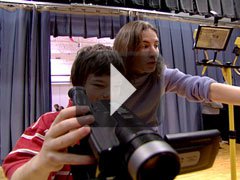
Running Time: 8 min.
Editor's Note: Although most of the teachers interviewed for this article have moved on since it was published in 2002, the school continues to infuse technology throughout its curriculum.
When Chapel Hill, North Carolina, teacher Kathleen Eveleigh goes over the day's activities with her students, she does so with the gratifying knowledge that she is fulfilling a host of educational goals.
As she asks for examples of the day's highlights from her Mary Scroggs Elementary School kindergartners or first graders (all Mary Scroggs teachers loop, which means they teach the same group of students for two years in a row), she types their answers into a computer. Then the children follow along as she reads their dictation aloud. The students are honing both reading and writing skills in line with an approach called balanced literacy.
"Who has something to tell me about what we've done today? Ram. Some people went to the reading center to read books. Very good. James. There were two things in the mystery sock. One was a bug. We had a fantastic super day! Wow! That sounds so good."
Paper, Pencil, and User ID
The students also are getting a feel for the importance technology plays at the 567-student school, which is 71 percent white. When students start at Mary Scroggs, their school supplies include a user ID and a password for the school's computer network.
A Mary Scroggs student monitors the audio portion of the school's daily news show, Ribbit News.
Credit: EdutopiaThe school received a major grant from BellSouth because of a commitment to integrate technology into the curriculum and a determination to close the digital divide. The grant also was contingent on using a "Power to Learn" approach to instruction, which uses brain research in determining different learning plans for students.
The Internet, a daily closed-circuit school television news show called Ribbit News (Mary Scroggs's mascot is a frog), wireless laptops, computers in every classroom, and software programs ranging from Inspiration to Software MacKiev's HyperStudio to Logic Blocks are an integral part of the learning package at the school, which enrolls students in grades preK-5.
Email gets heavy use, and has improved communication among teachers, administrators, parents, and students. Principal Paula McCarthy, who sends out a daily morning message via email to the teachers, notes that with just one click on the keyboard, she also can send messages to more than 90 percent of Mary Scroggs families.
To make sure no one lacks access to Mary Scroggs's technological advantages, families without the means to buy their own computers are loaned Internet-access devices for their homes. These gadgets, financed through the BellSouth, are not full computers (no data or applications can be stored), but they give students and their families access to a range of Internet sites, email, computer software, and the student's school folder.
Keeping Parents Informed
The Web summary of the day's events in Kathleen Eveleigh's class also promotes parental involvement, which in turn has been shown to lead to improved student achievement. Once Eveleigh and the class have read what the students dictated, it is put on the class webpage.
Peer helping, cooperative learning, and technology are essential elements of instruction at Mary Scroggs.
Credit: EdutopiaBy the time many parents come to pick up their children, they already know the specifics of the day. Moms or dads or grandmas or babysitters can start conversations about the pictures their youngsters drew of Martin Luther King Jr. They can talk about the glories of bird-watching because they know that their student spied blue jays and mourning doves through homemade toilet-paper-roll binoculars that day. Or they can ask questions pertinent to a class visit by a naturalist.
No longer do the adults have to play a guessing game about what was learned at school. Some parents have their students read the summary for them when they get home.
Every one of Mary Scroggs's 29 teachers has a webpage that may include a daily or weekly newsletter, homework assignments, announcements, volunteer opportunities, student work, a list of recommended Web sites, and even pictures of a teacher's dog or Questions of the Week, like this one from the webpage of second-grade teacher James Nohe:
If you could have one grown-up job, what would it be?
- United States President
- Voice for a Cartoon Character
- Professional Sports Star
- Teacher
- Actor/Actress
- Soldier
- Firefighter/Police Officer
- Something Else
Students may vote and then see immediate results. (As of this writing, "Professional Sports Star" and "Something Else" were tied, each with 37.5 percent.)
Heavy Use of Email
The Mary Scroggs teacher webpages make it clear that this is not a school where parents will be made to feel sheepish or self-conscious about asking questions or wanting to be involved. Principal Paula McCarthy and the teachers and other staff make a special effort to let parents know that their input is not just welcome, it is crucial.
Parent Dorothy Setliff joins her son Sam in reading homework assignments teacher Julie Crawford Janes posts on the class webpage.
Credit: Edutopia"Hello! Thank you for visiting our class Web site!" is the start of many teachers' webpages. They continue, "It is very important for teachers and parents to keep the lines of communication open. I look forward to getting to know all of you better! The best ways to reach me are via email or my school phone line. I will try my best to get back to you within 48 hours."
"I feel like I have a better connection with my students and my parents," says kindergarten and first-grade teacher Julie Crawford Janes. Besides using email for informal communication, Janes assigns email homework. "I can reply very easily to what they've written back to me. It's less paperwork. I don't have a stack of papers to go through that sometimes don't make it back home. It's just much easier to give them immediate feedback through the email."
The feeling is mutual: Parent Dorothy Setliff also praises the immediate feedback and the ease of getting answers without having to play phone tag.
"I'm very Internet connected," Setliff says. "I would much rather use email." She uses it for everything from telling the teacher who her son will be walking home from school with to asking homework questions.
Treating Teachers as Professionals
Janes says the last three years at Mary Scroggs out of a 12-year teaching career have been the best. A technology-rich environment is not the only reason. Teachers are shown they are valued in a variety of ways -- from verbal support, a say in such decisions as hiring, and the opportunity for collaboration with other teachers to having offices next to their classrooms with desks, phones, computers, and storage space.
Offices situated between two classrooms give teachers private space to work.
Credit: Edutopia"We wanted them to see what an emphasis we put on teaching and teachers -- treating them as professionals, raising morale, providing them with the tools and the resources so that they can be the best they can," says Paula McCarthy. "I think typically, over the years teachers, have gotten by on a shoestring. They're told they're professionals but sometimes not always treated as professionals.
For teachers, it's a big deal to have a phone that they can use throughout the day either to communicate with parents or to be available to their own families," she adds.
The school also provides time for teachers in the same grades to plan together, pays leader teachers and curriculum specialists more, and pairs inexperienced and experienced teachers in the same office so that younger teachers have mentors at hand.
Collaboration, Not Competition
Before she came to Mary Scroggs, says Kathleen Eveleigh, she was frustrated because she would hear about other teachers collaborating, sharing, and talking about what they were doing in their classrooms, "and it wasn't happening in my career. I felt like there was more of a competitive atmosphere, where teacher was trying to outdo teacher."
Grade-level teachers meet every other Wednesday to plan and share ideas and resources.
Credit: EdutopiaWhen the school was built (it opened in 1999 as the fifth new school in the Chapel Hill-Carrboro City Schools in five years), the idea was to start from scratch. "When we designed the school, not only did we design a new facility, but we really designed a new program," says Superintendent Neil Pedersen, a 2001 national finalist for Superintendent of the Year.
"What we found previously when we opened new schools was teachers were not necessarily stretching and changing the status quo as we had hoped," he adds. "We really explored the current issues in education and developed a model for Mary Scroggs that is somewhat different from the model in our other elementary schools."
Technology was one of the differences. So, too, were looping, an average class size of 19 in exchange for fewer teacher assistants, block scheduling, and differentiated instruction, in which learning experiences are tailored to individual students' needs, strengths, and weaknesses.
Design Supports Academics
The school architecture was designed to reflect such innovation and respect for teachers as professionals. An office for two teachers situated between pairs of classrooms was one manifestation of the new mind-set.
Innovative architecture allows teacher Kathleen Eveleigh to guide her students in bird-watching from a porch connected to her classroom.
Credit: EdutopiaOthers included the openness of the building and its natural light, project rooms and kitchens, wide corridors and stairwell nooks where couches or chairs or tables could be placed for reading or conferring, outdoor porches that were extensions of classrooms, and a two-story lobby that connects the two wings of the school and also is sometimes used for community functions. Rows of desks also have been replaced by tables for working together cooperatively or individually on projects.
In Phillip Thomas's fifth-grade class, for example, some students are working with volunteers on reading or math basics. Others are gathering information for a WebQuest project, in which the students are planning a stay and tour of Chapel Hill for people from around the country with different needs. One girl is using the phone in Thomas's office to call local restaurants in order to price meals.
The integrated learning plan that covers curriculum, learning spaces, and teacher support and training apparently works. Test scores have shown a steady increase over the years since the school opened. Mary Scroggs was designated one of the state's most improved schools in 2000 and in 2002 was named a North Carolina School of Excellence because more than 90 percent of the students passed end-of-grade tests with high marks.
A Team Effort
"We have great kids, terrific parents who are supportive, who volunteer and who fundraise for us," says Paula McCarthy, whose office is filled with frog replicas given to her by students and others. McCarthy even kissed a frog when the Mary Scroggs students met their book-reading goals.
Wireless laptop computers allow teachers to easily take advantage of technology.
Credit: EdutopiaWe clearly have a very supportive central office and superintendent who gives us the latitude to design a school the way we think it should be," McCarthy says. "And I think most importantly, I don't feel I'm making unilateral decisions or leading the school by myself. It's a team effort. And that's a wonderful feeling."