Teachers, Like Students, Learn by Doing: Project Learning at Envision Schools

By Bob Lenz

8/29/07

A quote by experiential-education pioneer Kurt Hahn projects brightly onto a large screen: “We are crew, not passengers.” After a brief welcome, the thirty-five new teachers at Envision Schools are asked to respond to the quote in their journals. Then, following some quiet reflection time, the teachers meet their fellow group members. (Groups are heterogeneous -- teachers come from different schools and content areas and have varying levels of technical expertise.) Within their new group, teachers then discuss their response to the quote and how they think the quote will impact the way they work as a whole over the next two days.
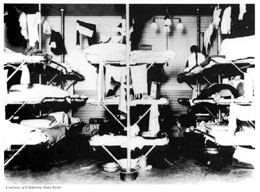
Teachers Learn by Doing
Credit: California State Parks

The Envision Schools facilitator then leads an activity on the attributes of high-quality stories. Next, she asks, “What do you think is happening in this photo?”

After discussing the photo, she then projects the graph below. “What could this data possibly be describing?” she asks, challenging this group of teachers-as-students.

“Together, we will explore the essential question ‘Why do we exclude people?’ by exploring the Angel Island Immigration Station,” the facilitator explains. “Each group will propose an answer and present their findings through a digital story and free-verse poetry. Hopefully, your curiosity is piqued. Let’s go -- we have a boat to catch!”

The teachers and the facilitator catch the next ferry to Angel Island, in San Francisco Bay, to spend the day learning about immigration and exclusion by visiting the Angel Island Immigration Station, a facility that detained Chinese immigrants in the early 1900s. Teachers will spend the day learning from expert docents, exploring primary source documents, reading and writing free verse (the walls of the Immigration Station are covered with the immigrants’ original poetry), studying challenging historical documents using literacy strategies from the Strategic Literacy Initiative (SLI), and finding answers to the questions raised by the above photo and chart at the Angel Island museum.

After a long day on the island, the students are given their assignments: Consider the question of why humans exclude others and create a response using evidence gathered on Angel Island. This homework is also aligned with the Envision Schools performance-assessment system. (If we, as facilitators, had more time, this homework assignment would be the first step toward an essay that could be used in a Lower Division Benchmark Portfolio or a Graduation Portfolio.)

The teachers will then use the Oracle Education Foundation’s Think.com Web site to post their responses. This assignment will prepare the teachers for their tasks the next day: To answer the question of exclusion, they must create and present a short digital story using Apple’s iMovie and create and present a free-verse poem. In addition, both assignments have benchmark assignments that must be completed and assessed by one of the school’s facilitators.

The next day, teachers arrive early and ready to go to work -- the power of public performance motivates younger and older educators alike. The groups work diligently and frantically during the morning to complete their digital story and their poetry and present them to the larger group, in addition to other members of the Envision Schools professional-learning community, that afternoon. Through the experience, teachers learn that a project-based-learning classroom feels a little like chaos -- managed chaos. It is definitely clear PBL is active learning. They also learn that the power of performance can motivate even the most reluctant learners.

As great as the learning is during the “doing” stage of PBL, the real learning occurs during reflection. The facilitator asks folks to reflect in three ways: as individuals, as a work group, and as a large group. Teachers quickly move from making generalizations about the experience and its implications to applying what they’ve learned to the teachers’ future classrooms, their integrated project-based teams, and their schools as a whole.

They introduce the tools used for design -- the Six A’s of PBL, Simultaneous Outcomes, and Balanced Assessment (see below) -- and discuss how to use them. It is clear these are the types of activities and projects expected at Envision Schools. Finally, the teachers get to use these tools to design projects with support from facilitators (this type of support continues throughout their career at Envision Schools, with fifteen days of student-free professional-development time annually, five hours of collaborative time weekly, and monthly classroom mentoring).

Though this two-day experience is merely a slice of a project and is really just a PBL teaser, teachers leave excited and motivated to design their own powerful experiences. Envision teachers leave as members of the crew, ready to change lives and prepare students for success in college and beyond.

What do you think of this learning/teaching assignment and process? I'd be interested in your comments.

Teachers, Like Students, Learn by Doing: Project Learning

Submitted by Katherine Underhill (not verified) on May 13, 2008 - 11:33.

I agree that students learn best by doing, in fact that is how I learn best. I was drawn to this blog because as a teacher with multiple special needs students, I am always looking for ideas on integrating a more hands on approach to learning for my students. Students take pride in work they produce themselves and enjoy the freedom of expressing themselves creativly.

Put ourselves in their shoes

Submitted by Jo P (not verified) on November 27, 2007 - 20:18.

I think it is exciting for students no matter what subject to do hands on projects. It solidifies the content of the information they have studied. As a visual art teacher at the middle school level, I use this in reverse. Students always think of art class as one project after another. They think it is simply going in and drawing or painting and not really thinking about “learning” information. I give them “jumpstart” work such as listings and definitions of art elements and principles of design. Then the artwork they do contains one of the art elements and at least one of the principles. This way they do not just do the project; they value art as a subject.
Besides who doesn’t like getting out the watercolor paint and brushes?

I was drawn to this blog as

Submitted by tdecoff (not verified) on November 27, 2007 - 07:34.

I was drawn to this blog as it was connected to a reading that I am doing in my master's program. It is certainly true that real life experiences are crucial for the most beneficial learning to occur. Our brain can process these experiences and recall them with greater ease in the future. This is an important lesson for all educators to realize. We often forget the importance of letting our students explore the world around them. Thanks for this interesting experience of a professional development class.

Learning by Doing

Submitted by Wayne Bennett (not verified) on November 26, 2007 - 14:23.

I must agree, learning by doing is very productive. I've been teaching for twenty-two years and the number of staff development days that have been productive can be counted on one hand. However, a couple of weeks ago we had a staff development and the presenter had us do the brainstorming and hands on projects throughout the two day presentation and I can safely say that those were two constructive days for me.

Learning By Doing

Submitted by Katie Hannen (not verified) on January 24, 2008 - 10:41.

I completely agree that it is much easier to learn something by being involved and actually doing it. I have participated in one assembly that the presenter had the teachers participate. It was a lot of fun and I still remember things from it. The speaker was from Applebaum and was terrific!

Active Particpants

Submitted by Mandy (not verified) on November 25, 2007 - 13:33.

I feel that this is an age old idea that we as educators forget. When a young man wanted to become a blacksmith he did not take a class to have someone tell him how to wield the metal he became an apprentice to gain hands on experience and valuable skills. When teachers and students alike are gaining hands on experience we are learning actively as opposed to passively and we retain more. I have recently begun a master's program and the distance learning is a brand new concept to me but is very applicable to this topic. I consider myself computer literate, however, I am not savy, but I have gained a lot of knowledge in just these few short weeks because I am forced to try and experiment as I am learning in the class and I have retained more because I have been willingly forced to become an active participant in my own education.

I liked your analogy

Submitted by Laurie Strickland (not verified) on January 30, 2008 - 19:07.

I loved the analogy you posted about the blacksmith. I feel hand-on learning is essential in our schools. Kids don't get excited about sitting and listening to a lecture. Although it may take some extra effort to prepare a hands-on activity I think it would be well worth it in the end. I know when I teach a concept using hands-on activities the students retention is so much better. Months later they will say, "Oh yea, I remember this from that fun science experiment we did... etc."

Teachers Learn By Doing

Submitted by Tabitha (not verified) on November 25, 2007 - 09:37.

Teachers just like students do learn by doing. I find that when I am in a workshop and I can actually see a presentation, take notes, and make something to use in my classroom I have learned. I make every effert to do this with my third graders. When I plan I try to incoorporate hands-on project based activities to engage my students and have them see how they learn and produce a project that show themselves and myself that they have learned what was stated for them to learn. I try to incorporate projects, fill out a graphic organziers, watch video clips or power point presentations when I introduce a new concept.
I find that when I get to do the same things that I provide my students the opportunity to accomplish in my class I walk out with a new knowledge that we all know helps our students and us in the end.

All things that help build a life long learner

Submitted by Rod Hite (not verified) on October 23, 2007 - 19:16.

I agree that using any and all technology, visual, and hands on images or sites to help build life long learners are to our advantage as educators. Imagine if every student in our classrooms came to class excited from the prior class or enthusiastic about learning from their prior year of school. These are the students we dream of as teachers, yet we miss out on opportunities to create this enthusiasm because we get too "busy" to take time to use some of the techniques mentioned. I love seeing some teachers are still building student dreams and teaching students and teachers there are more ways than one to educate.

I thought that the article

Submitted by angela (not verified) on October 23, 2007 - 19:05.

I thought that the article proved a point that we should all try to keep in mind. That we are life learners. Helping students understand and learn to enjoy this aspect of life at a younger age will help them become even more inquisitive as they mature.

Post new comment

Share your thoughts on this story. Please increase the credibility of your post by including your name and city, and by demonstrating respect for others' opinions. Comments will not appear immediately; all comments are moderated and will be posted in order of submission.

The content of this field is kept private and will not be shown publicly.
  • Allowed HTML tags: <a> <em> <strong> <cite> <code> <ul> <ol> <li> <dl> <dt> <dd>
  • Lines and paragraphs break automatically.

More information about formatting options