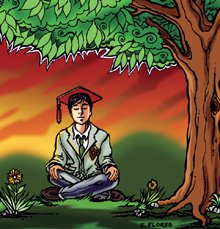
Unacceptable: Many Teens Aren't Emotionally Ready for College
It's time to redefine "college prep."
by Jill Flury

Credit: Indigo Flores
In dorm rooms and shared apartments across the country, anxious college freshmen are unpacking their bags and moving into the next phase of their academic journeys. Having successfully navigated the educational system thus far, these budding intellects are ready to take on the demands of higher education.
Or are they?
College enrollment is up, due in part to the increasing focus on helping kids get accepted. They are thrown on the college track as early as elementary school, and in many places they get institutional help in meeting college-admission requirements long before high school. More and more, private tutoring and counseling add to the acceptance chances of those who can afford it. Why, then, with all of this college prep, are the attrition rates of first-year university students so high? According to the 2007 "Condition of Education" report, by the U.S. Department of Education's National Center for Education Statistics, nearly half of all college freshmen never earn a degree.
This dropout rate, in many cases, is not due to any lack of academic skill. Instead, the reasons are related to a lack of emotional, social, and self-care abilities needed for a major life transition. Numerous studies cite self-esteem, stress, anxiety, depression, and minor health issues as the most accurate predictors of grade-point averages and enrollment-retention figures for college freshmen. The honors courses, standardized tests, and practice application essays that are the heart of the present college-prep formula do little to prepare students for these challenges. We have figured out how to help kids get accepted to college, but we fall short in helping them cultivate the skills needed to prosper there.
It is time to redefine "college prep." Getting into a college is just part of the goal. We need to look beyond acceptance to the crucial adjustment kids have to make to life once they are there. College living demands a skillful shuffling of academic expectations with the excitement, pressures, and demands of living independently -- often for the first time. Personal wellness, maintained through solid coping skills and knowledge of holistic health, needs to be as important as academic excellence for students who want to thrive in college once they clear the admissions hurdle.
I am not talking about adding some New Age peripheral fluff to the social-psychology class. I refer to the kind of realistic and practical self-care training that is effectively transforming the corporate world, the medical system, and other major institutions concerned with production and success. This preparation is a matter of recognizing potentially self-destructive stressors in a new situation and, given this particular audience, finding a fun and engaging way to teach proactive, preventative actions to cope with them.
An ideal college-prep curriculum would be based in experiential practice and would emphasize self-reflection. High school students would explore various ways to prevent, manage, and respond to stress, and they would have the opportunity to discover what works for them before they succumb to the chaos of college life. Coursework and assignments would look at vital, practical issues such as the role of exercise and diet in emotional well-being and the value of time management, financial health, and social skills. Activities would be designed to give students a strong sense of self and self-efficacy, as well as the resources they need to cope with change. The idea is for students to get some practice in being independent in self-care before they are actually out there on their own.
College is a time of self-discovery. It is a period when students try on different roles and characters, test their limits, and take risks with their new freedom. Without a strong sense of self and the tools necessary to weather the inevitable turbulence of this life change, it is all too easy to drown in doubt, confusion, and, in worst cases, self-destructive behavior. We need to make wellness wisdom an integral part of college prep, not just to make sure that our kids graduate but also to improve the quality of their college experience.


I think Ms. Flury is dead-on with her assessment in lack of preparation on 'life skills', particularly as related to college-bound adolescents. There are a tremendous amount of students that are not ready for the daily pressures of adult life at 17 or 18, let alone equipped with the security of self that will allow them to make good choices, both academic as well as social. Traditionally in this country, much of an individual's education is strictly concentrated on scholastic achievements alone. However, a well-rounded education should include emphasis on career success and life success, which is firmly rooted in a strong sense of well-being. I applaud Ms. Flury for her efforts in surfacing this important issue and look forward to reading more from her on the subject.
Ms. Flury article
I have seen many high school students take a few college classes while still in high school. Over the course of two semesters they learn how to manage thier time, handle stress and mature as students. They are not coddled but made to work as hard as any other college student. The dual enrollment students are not left to fend for thenselves but have family and friends to support them. This seems to be a half way step to prepare them for the University experience.
Education already has the ability to address these topics in comprehensive health education. Certified health education teachers should be in every school, elementary, middle, and high school, and school systems should have a curriculum that aligns to the National Health Education Standards and the critical areas identified by the CDC. If students participate in comprehensive health education (at least 60 hours every year) they will be better prepared to handle the rigors of independent living.
WHY COLLEGE ANYWAY?
I recently heard an ad that stated:
"You know you need that Bachelor's degree to be competitive in the changing economy." This is not always the case since only 20% of US jobs require a 4-year sheepskin.
All this focus on going to college has caused school districts to shelve some electives (including valuable technical education classes)and shove everyone into college training (preparatory programs)ignoring the glaring fact that NOT ALL people are cut out for the rigors of college.
College students who can't cut the proverbial mustard are then saddled with student loan debts they cannot repay (insufficient income).
I have an MS and I make less than most sanitation engineers and custodial personnel. So what is the value of my college degree? I get to sit in an office, big deal; I'd rather have more money. Afterall, I put my time in (6-years) of "HIGHER EDUCATION" to make less than high school graduates.
Perhaps if the option for technical education had been offered I would have had 2 - 4 years of technical training and be enjoying a higher paying job.
NOT EVERYONE IS CUT OUT FOR COLLEGE!
NOT EVERYONE NEEDS A COLLEGE DEGREE!
BUT EVERYONE NEEDS SOME KIND TRAINING!
I couldn't Agree More
We work with at-risk kids, mostly in the inner city. One example is a kid who was the star of the center. The leaders pushed her on to college and raised the money for her to get into a private university. It was so out of her realm she couldn't deal emotionally and today is living on the streets. Too often we adults push the kids to do what will make us feel good rather than critically thinking about what will be best for the kids. www.kidtrek.org
I completely agree with this article but think we should put most of that emotionally readiness on the shoulders of the parents. It is the responsibility of the family to prepare these students for living on their own and managing time and money. Yes ... the school system can help but parents should know their children and whether or not they can handle living on their own and the stresses that come with that and their studies. I teach high school and I have two children in college. The school CANNOT be their parent.
My parents did not push me to get into college but they did show me how hard work, being responsible, and taking steps to move my life forward were the life skills I would need. In 1984, I went away to college, struggled, experienced hard times, and worked a couple of jobs to make things happen. Had my parents not provided me with those tools to handle the non-standardized test scenarios, I would have probably become a statistic in a Department of Education report.
Today, it seems as though parents are more focused on aspects of life that can be graded – e.g. school work, reports, test scores, etc. And not on the tools/skills needed in day to day life - one is not more important than the other as I view them as compliments. Being knowledgeable and knowing how to implement that knowledge to have a “successful” life is far more important than doing well on any test.
The hands-on approach of project based learning and the pragmatic training suggested by Ms. Flury, are absolutely proactive steps in the right direction.
I'm 23, still in school, have 2 years of computer repair skills, a 2 year degree, and I still suck at life. yay for me! I guess i should just kill myself because my parents didn't bother to raise me the right way and I can't find work that pays more.
Jill Flury/Emotionally Mature Teens
I agree with the premise of the article especially when considering college readiness. Of course, academic skills are most important when transitioning to college, however, they are often considered in isolation of emotional and social intelligence. Students who are successful when living away at college must have a balance in all three areas: academic, emotional and social intintelligence. It may be up to parents and those who are more closely tied to the student to evaluate readiness in these areas rather than the colleges/universities. Those who are not as mature would benefit from a gradual immersion into college life with a local, live at home initial experience with a smaller courseload and more responsibilities. As greater responsibility and committment is demonstrated over time, then possibly consider an on- campus experience. Less is sometimes more with a gradual positive experience rather than an intense immersion into college life for a student who may not be ready. Daniel Goleman's books on emotional and social intelligences are good resources in these areas.
Americorps option
I was one of these statistics....by following what my peers were doing, I coped with college stress by drinking constantly and having casual sex. After my freshman year, I started taking yoga and joined a women's support group, but still had no idea how to handle---having an apartment, dealing with money, getting to the grocery store without a car, cooking food, fixing the hot water heater, doing Lots of school work, and boys.
Midway through my sophomore year, I dropped out of college. Shortly after, I joined Americorps and did a year of civil service. It was hard work, but we had lots of training, clear guidelines and expectations, and an understanding that what we were doing was helpful and important. I'm back in college again now, and I feel worlds more confident, comfortable, cable and focused.
I don't think that a high-school wellness class would be particularly helpful or easy to execute. But an expansion of Americorps could be wonderful, since people tend to learn those skills without even knowing it. So if your worried about your child, I would recommend them taking time of to do that, or perhaps a NOLS wilderness course.
BTW, in Germany right now its mandatory for all young people to do one year of civil/military service, anywhere in the world.