Services

print articleForward ArticleLeave Comment

Advertisement

Civics Unrest: On Teaching Kids to Love Democracy

With a presidential election on the horizon, teaching about our country takes on new importance.

by Richard Dreyfuss

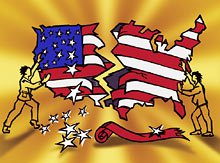
Civics Unrest
Credit: Indigo Flores

I believe America is a verb, not a noun. America is the greatest opportunity for people to live in fairness and decency, but only if you accept the idea that America is an ongoing activity, rather than a done deal. America as an evolving concept has meaning; our country offers more potential for human freedom and mobility of mind than any other sovereign nation created in the last 10,000 years. But if America is just a noun, a static object, it should be treated as any other nation. Nothing special -- simply a place that is south of Canada and north of Mexico.

One of the fundamental tenets of our democracy is that we allow and share disparate opinions. That principle must be honored. If we do not honor disparate opinions -- if we heap scorn and contempt on those whose ideas differ from our own -- and if we humiliate dissenters for exercising their right to dissent, we are being fundamentally antidemocratic.

This is an important point to teach our children, and this is why it is critical that we continue to teach our children both civics and civil debate as a key part of our schools. If we no longer teach these skills and we expect our children to inherit this great nation, it's like giving someone the keys to the car without requiring them to first obtain the skills needed to drive.

The expertise needed to understand Western enlightenment and civil liberties is not something you are born with. You have to learn it. Unless we teach our kids the ideas that make America -- the government -- a miracle, it will go away in their lifetime. We must find the time and creativity to teach civics in school. If we don't, we will lose it to fundamentalists of every stripe and to stupidity and the darkness.

A great example of this danger is our modern excuse for debate, particularly televised debate. We don't show that complex issues require time to understand. We don't reason things through. We don't applaud rumination and taking your time.

Instead, we watch the Bill O'Reillys and Sean Hannitys and call it discourse. But is this really debate? Of course not. Politics and news have been hijacked as mere sources of entertainment. We confuse the melodrama of incivility with how public issues are meant to be discussed. Is this the way we want our children to behave: insulting, annoying, and loud? Is this something our kids should emulate? Instead, we need to teach our kids the tools of reason, logic, clarity, dissent, civility, and debate. We must teach them that it's OK to keep asking new questions. Those things are the nonpartisan basis of democracy.

What has happened in America is that we have confused confrontation and opposition with discussion. We have turned debate into entertainment. And we have created a system where dissent -- the essence of a democracy -- is considered antipatriotic, when in fact the opposite is the case.

Democracy is hard work. It requires our attention, because if we don't use it, we lose it. Democracy will not go away in a single dramatic event. No one will ever say that this is the day it died. But this is the state of things now: Unless we are careful, America will turn into a legend, a story, a fable. All it takes is some inattention. It takes a belief that we don't count. It takes cynicism in our country. Cynicism is probably the least attractive thing ever created, and it always comes from a broken heart. The only reason people get cynical is because of love gone sour: At one time, there was an America we loved, and now it's gone sour.

This country, the idea that we are responsible for our own government, represents a tiny twinkle of light in a long world history of monarchy and theocracy and oppressive darkness. If our form of representative democracy lasts longer than our lifetime or our kids' lifetime, it's only because we put some effort into teaching the ideals of opportunity, mobility, freedom of thought, and assembly.

America in its imperfection may be unsatisfying, but it is alive. And it is up to us to make sure America keeps on living. Kids must be reminded of the great parts of this country -- the parts that aren't always so easy to see or hear. Unless we give them something to fall in love with, why should they be in love?

Civics Unrest
Credit: Indigo Flores
Richard Dreyfuss is an actor who has appeared in more than forty films, including every teacher's favorite: Mr. Holland's Opus. This column is based on remarks he made at the 2007 Teaching & Learning Celebration conference, held in New York.

This article originally published on 1/12/2008

This article was also published in the February 2008 issue of Edutopia magazine.


Particularly hateful?

Submitted by Michael (not verified) on March 3, 2008 - 17:07.

Please explain this to me. After reading this I went to MoveOn's web site to find the hatefulness apparently inherent in its content. Marlene, please direct me to the items that are "particularly hateful." My guess is you won't, or can't. O'Reilly once referred to this group as "communist rat bastards", and I don't get that one either. Is it because they have different ideas than you do? Is it the grass-roots nature of this organization? Particularly hateful communist rat bastards sound pretty scary to me. How come I can't see through their thin disguise?

Democracy must be experienced!

Submitted by Bruce Smith (not verified) on February 15, 2008 - 16:12.

I find it interesting that Dreyfuss' article and the comments as of this afternoon all omitted what to me is the critical point: that democracy cannot be adequately taught as a classroom topic. As President of the Center for Advancing Sudbury Education, it frustrates me greatly that we talk about the importance of instilling students with an understanding and love of democratic principles even as we educate them in very undemocratic settings.

In contrast, schools following the Sudbury model of education know that democracy must be lived if it is to be learned. These schools are working democracies in which all students and all staff have one vote in all matters, from rule-making and -enforcement, to budgeting, to personnel decisions.

Until our schools are themeselves run democratically, we cannot expect our children to know what democracy is truly all about.

Dreyfus

Submitted by Marlene (not verified) on February 7, 2008 - 15:24.

It's interesting that Mr Dreyfus should mention Bill O'Reilly and Sean Hannity while leaving out a particularly hateful organization - Move On. I'd much rather my students watch the above mentioned political commentators than to think that what Move On does is OK when it comes to expressing politcal views.

Um, yeah, right....

Submitted by Wes Priest (not verified) on February 13, 2008 - 07:27.

Argh, people like Marlene are completely missing the point of Dreyfus's essay. Getting students excited about the ideals of America requires work and effort, and this should be the goal of ALL educators and parents. O'Reilly and Hannity do not, in any way, positively contribute to this goal. They are entertainment, and, unfortunately, too many Americans have conflated the idea of political discourse with this kind of vile entertainment. The result? A lot of chest thumping and schoolyard posturing, a lot of light and no heat. And this false bravado wears the mask of enlightenment. How sad.

And Marlene's reference to MoveOn? This is a straw man argument, and has nothing to do with the essay. By drawing attention to the fact that Dreyfus referenced two bellicose conservatives in the media in his essay, Marlene is attempting to discredit the substance of the entire essay (a tactic, not coincidentally, used by Hannity and O'Reilly all the time). The rise of Olberman and Maher (in his current iteration) are a reaction to this very slimy rhetorical device.

Remember, MoveOn, Olberman and Maher only found their voices after the rise of Hannity and his ilk. Oh, yeah, and the former don't lie. And to think that an educator would rather have his or her students listen to Hannity and O'Reilly than to critically look at the aim, mission, and accomplishments of a grassroots organization like MoveOn that has registered thousands to vote, shed light on internet privacy issues and challenged/questioned President Bush on the war in Iraq (and questioning your government is not a right...it's an obligation) is frightening.

Thanks for including Dreyfus's essay in this edition of Edutopia. My students have read it, as well as the comments posted at the end.

Re: Richard Dreyfus

Submitted by S. Marks (not verified) on January 29, 2008 - 07:59.

There is one very basic flaw in Mr. Dreyfus's musings; our country is, in fact, not a democracy. In truth, the men that authored the most basic documents of our country's beliefs, the Declaration of Independence and the Constitution, went out of their way to avoid even the use of the word. Yes, we as teachers have the responsibility to teach our children to cherish this country and it's principles, but we should remain true to those principles and teach them as they stand, not as some would prefer them to be. Our Consitition does not even guarantee the RIGHT to vote to every citizen; the states were to decide who was to be a voter, the Constitition only puts limits on what reasons the states CANNOT use to decide who votes. It was never the intention of the Founding Fathers to allow "one man, one vote". Keep in mind why a true democracy doesn't work: a gang rape is a democracy in action...

Civics Unrest by Richard Dreyfuss

Submitted by Len Gomberg (not verified) on January 19, 2008 - 10:34.

I agree with Mr. Dreyfuss' comment that we allow and share disparate opinion in our civic discourse in the classroom. However, when he heaps scorn on Bill O'Reilly and Sean Hannity and leaves out Keith Olbermann and Bill Maher, he loses all credibility. In an America where disparate opinion is shared, convservative as well as the liberal opinion must be permitted, and our educational leaders and faculty don't seem to want to allow that. Until conservative as well as liberal points of view are allowed in the classroom, the cynicism that Mr. Dreyfuss decries will continue, along with the political polarization of our society. Edutopia should consider printing viewpoints of conservative as well as liberal speakers, if its staff believes in the principles Mr. Dreyfuss has outlined in his article. If that ever does happen, I will have much more respect for the Edutopia staff.

While Keith Olberman and

Submitted by et (not verified) on February 8, 2008 - 07:11.

While Keith Olberman and Bill Maher can get on their soapboxes, at least they do not make up facts or
take messages out of context. You do not have to agree with them, but I believe they make an attempt to be
fair. Bill Maher especially sometimes agrees or understands some conservative viewpoints.
We need to teach our students how to be critical thinkers. We need to teach them what is opinion, what is fact.
It is difficult when opinions or political agenda are reported as truth or fact.

It is detrimental to our students and our country to be led to believe that any political editorialist is delivering information
without a slant.

Post new comment

Share your thoughts on this story. Please increase the credibility of your post by including your name and city, and by demonstrating respect for others' opinions. Comments will not appear immediately; all comments are moderated and will be posted in order of submission.

The content of this field is kept private and will not be shown publicly.
  • Allowed HTML tags: <a> <em> <strong> <cite> <code> <ul> <ol> <li> <dl> <dt> <dd>
  • Lines and paragraphs break automatically.

More information about formatting options