What Works in Public Education

From Brain-Based Research to Powerful Learning: Innovative Teaching Techniques in the Classroom

Educators explore nontraditional methods of teaching and receive positive results.

by Diane Curtis

Print Forward Share Comments(122) Comment RSS

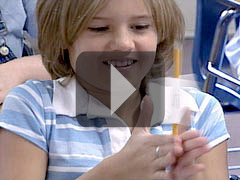
VIDEO: Using Tech to Understand How the Brain Learns

Running Time: 10 min.

Craftsmen in ancient Egypt used many different kinds of tools to do their work.

Instructions: Look at the tools and read the cards that describe them. Match the tools with the craftsmen by clicking on the empty boxes. If you change your mind, just click on the box again to return the card to the pile.

When you have put a card in each empty box, the computer will work out how many you got right. Keep trying until you get them all right.

In Suzan Hale's third-grade class at Florida's Key Largo School, students have a variety of ways to learn about ancient Egypt: They can go the traditional textbook route. They can use encyclopedias and other research material at the library. They can check out a video. Or, they can do what feels like second nature to so many of them: They can head for the computer and take advantage of intriguing, meticulously researched interactive sites like the one above from the British Museum.

technology integration

Principal Frankie St. James visits classrooms at Key Largo School every day.

Credit: Edutopia

The World at Their Fingertips

Technology, whether it is a computer, video or telecommunications equipment, or a global positioning system (GPS) device, is embraced at Key Largo, a P-8 school of 1,200 students where all classrooms are wired and where the student-to-networked-computer ratio is 3 to 1. As Principal Frankie St. James says, technology provides "a classroom without walls or limitations for pursuing information."

Key Largo received a two-year, $250,000 BellSouth Power to Learn grant in part because of its leadership in using technology and spending the time and money to train teachers to incorporate it into their instruction. The Power to Learn part of the grant refers to adherence to conclusions outlined in the book, How People Learn: Brain, Mind, Experience, and School. First published in 1999 and written by a committee of scholars established by the National Research Council, How People Learn details research on learning and comments on the implications of such research on what is taught and how.

Based on brain research, technology provides opportunities to use such important science of learning principles as pre-existing knowledge, active learning, mental models, transfer, and learning for understanding.

A list of disconnected facts doesn't lead to deep understanding or to easy transfer of knowledge from one situation to another, according to the book. However, knowledge that is organized and connected around important concepts and mastery, which includes being able to visualize a concept, does lead to transfer and deeper, longer understanding.

technology integration

A television news show is one example of widespread technology at Key Largo.

Credit: Edutopia

Doing and Visualizing

"Because many new technologies are interactive, it is now easier to create environments in which students can learn by doing, receive feedback, and continually refine their understanding and build new knowledge," according to chapter nine of How People Learn, "Technology to Support Learning." The new technologies can also help people visualize difficult-to-understand concepts.

Take the kindergarten classroom of teacher Kathy Caputo, who headed for the computer when she wanted her kindergarten students to understand how a flower opens, and she takes daily advantage of the myriad ways information is presented on the Internet. The online video clips she shows her students ensure that students have a visual image of a concept. It also allows them to start from the same place so that misconceptions that can impede the learning process are addressed before moving on. To set the stage for a book set in a snowy climate -- something few of her Floridian students had experienced -- Caputo had her class try to see their breath in a refrigerator; brought in a pair of mittens, and, again, headed for the Internet.

The importance of being able to transfer knowledge from one context to another accompanies the belief stated in How People Learn and held strongly at Key Largo -- that it is "better to 'broadly educate' people than simply 'train' them to perform particular tasks."

technology integration

Controlling the environment at Key Largo, such as replacing fluorescent with soft lighting, is made to fit the student, not the other way around.

Credit: Edutopia

From GPS to Probes

Technology is everywhere at Key Largo. In one class, middle school students are using digital cameras, probeware, and a GPS device in collaboration with younger students at a different school for a study of the Keys. They share information via videoconferencing and post their findings on the Monroe County Community Atlas Web page.

Other students film school and community activities, including law enforcement, the fire department, the ambulance corps, hospital staff, and U.S. Fish and Wildlife Service employees for a feature aired on the Monroe County educational television station. There is a daily television and radio show at the school via closed circuit, and seventh graders produce public service announcements for a local radio station.

Students in fourth grade without access to computers at home are offered older computers that connect to school software and the Internet through Key Largo's server. Sixth graders are being issued laptop computers. Younger students use a software program that lets them work at their own pace. And PowerPoint presentations are almost as commonplace as written assignments.

Technology is just one way Key Largo fits school to the child, not the child to school.

technology integration

A student in Jeanne Kurth's eighth-grade class performs a series of movements called Brain Gym designed to improve concentration, organization, and other learning skills.

Credit: Edutopia

Taking Risks

Principal Frankie St. James is not afraid to stand by a program, no matter how unusual, if it produces kids who are more able and eager to learn, whether it's an adopt-a-pet program for all third graders (choices include a boa constrictor), a daily television news show, or a cooking-themed fourth- and fifth-grade class.

Eighth-grade teacher Jeanne Kurth has found one of the strangest-looking exercises: Brain Gym, also one of the most beneficial. Students do a series of twenty-six movements, such as placing two fingers on the chin while moving their eyes up and down, or rubbing both cheeks, to promote concentration, memory, organization, language, and other skills.

Kurth, like some other teachers at Key Largo, checks for a range of student dispositions before creating individual learning plans. Does the student work better in groups or alone? Does she remember more if the information is told to her, if she sees it in writing, or if she is given a project and allowed to discern the knowledge through hands-on work? Is he easily distracted, or do noise and activity propel him to work harder?

As a result of those answers, harsh fluorescent lighting has been replaced with the soft glow of 60-watt bulbs in real table lamps. CD sounds of a rushing stream serve as background music. Eating (healthy) food in class is encouraged."Part of the brain research tells us that children have different learning styles, and that if we want them to do the very best they can in life -- in school -- then we as educators need to tend to what their learning styles are," says St. James.

Diane Curtis is a veteran education writer and a former editor for The George Lucas Educational Foundation.

This article originally published on 2/25/2003

Advertisement

@edutopia on Twitter Edutopia on Facebook RSS feed link

Advertisement

0
was this helpful?
Carrie
Posted on 1/13/2008 6:50pm

Wow! Key Largo is an amazing school! I like the way the younger students work collaboratively with the older students on experiments and technology based projects. What a great way to build background knowledge and introduce technology to the younger students. I would love to see how the teachers at Key Largo keep all of their students' learning preferences/differences straight. I have questions! What is the typical class size at Key Largo? What is their school profile - ELL students, Special Education students, etc.? Is Key Largo as innovative with struggling readers? What interventions do they have in place for their struggling readers, specifically at the first grade level? How often do teachers participate in technology based professional development?

0
was this helpful?
Charles Schmidt
Posted on 1/18/2008 1:41pm

Brain Based Learning

It was very interesting to learn there are schools in Florida involved in brain based learning. Key Largo must of had some forward looking teachers and administrators to have come this far. You all set a great example for what could come to pass with the right direction, resources, and leadership. Did you have a grant writing committee already established, or did you start one with intent to get awarded with the Bell South grant money? You must of had the foundations in place to take advantage of the funds the grant gave you. What was the process like in deciding how the money was spent? Keep up the good work!

0
was this helpful?
Cami
Posted on 1/24/2008 6:30pm

Great Example of Following Brain-Based Research!

I am encouraged by the fact that this school not only read about the latest brain-based research, but they did something about it! It is frustrating to sit in staff meetings and hear about how children should be taught, and then feel as though I am supposed to teach to the test (even at the kindergarten level!). Principal St. James mentioned that she wants to teach students "how to learn rather than how to pass a test," and in doing so, the students are also scoring well on standardized tests! This is a wonderful example for teachers/districts who are afraid to follow the indications of brain-based research and instead focus solely on test scores.

Where do these students go for high school, since this is a preK-8 facility? I know it is frustrating when I teach my students things (such as Sign Language) that are not used by their future teachers. When there is no follow-up, I feel as though I have wasted my time on what I believe to be important skills.

0
was this helpful?
Cami
Posted on 1/24/2008 6:45pm

Process rather than Product

I completely agree with your thoughts about parent involvement/understanding! That is the key to success. My district uses an inquiry-based math program called "Investigations," and many parents dislike it because it is not what they learned when they were in elementary school. They would prefer rote memorization of facts to new activities that help students develop true number sense. The administration and teachers are on board with Investigations, yet even after many years of using the program, a lot of parents are still skeptical. I can only imagine what they would do if our school/district did something as (wonderfully) radical as this!

0
was this helpful?
Shanda
Posted on 1/26/2008 8:24am

Teach to learn not to test

I pulled this article too, to help with discussion and application assignment for Walden U. I agree that our school systems are concerned with test scores and we need to be concerned with our students' learning. Brain-Based Research, if applied correctly, sounds like the answer to the questions of all involved.

0
was this helpful?
Jamie Long
Posted on 1/27/2008 3:00pm

Brain research

I enjoyed reading about the brain-based activities that have been implemented. I am happy to discover that the children are given hands-on technological activities that expand their learning. I was pleasantly surprised to read about students given the opportunity to participate in Brain Gym activities. My school district requires Brain gym as a daily morning exercise for the students to complete each day. The students will listen to the morning announcements and then as an entire school, the students and staff actively participate in Brain Gym. The children love to do Brain Gym each morning and I do think it helps them to focus mentally on their school day. I highly recommend being an active member in the use of Brain Gym and being able to implement its various forms of brain exercises.

0
was this helpful?
Jamie Long
Posted on 1/27/2008 3:14pm

Brain research

It is wonderful to learn that you allow your students Brain Gym breaks throughout the school day. Do you find one particular time more effective than another does during the school day? My school as well as school district implements the exercise each morning but then it is up to the individual teacher to make use of it for the remainder of the school day.

0
was this helpful?
Terri
Posted on 1/29/2008 5:07pm

Brain-based Learning

Key Largo has taken the idea of differentiation and practically put it to use. When we as educators partner what research tells us about improving learning with students' individual learning styles we can expect great things! I applaud the administration and the staff for taking the risk in new and often uncharted territory. Personally, I have found new reading software becoming more and more interactive which helps give feedback to my struggling readers. Instead of "watching" a phonics lesson, my students can sort words via software and make words on their own. I see benefit from the visual cues and the interactive lessons.

0
was this helpful?
Jennifer S.
Posted on 1/30/2008 12:32pm

I am a student at Walden University and we're studying brain-based learning this week. I found this article to be motivating for me as a second grade teacher. It sounds like this school in Key Largo is on the right track to incorporating brain-compatible instruction. To be honest I have to question how these techniques could be incorporated to a low-income school like the one that I teach at where funds are very limited.

0
was this helpful?
Ana Reyes - Maplewood, New Jersey
Posted on 2/13/2008 4:41pm

Social Studies and Math Teacher

The teachers of Key Largo are doing amazing things with technology. I applaud the Principal of Key Largo for supporting the new and innovative ways that the students and teachers are using the new literacies. I very much like how the district makes sure that all students have access to technology by offering older computers to children and connecting them to the district server. By doing this, this school district is give every child the opportunity to connect with the Internet and be successful. It is simply a matter of equity.

Post a comment

Sign in or create an account now, or after you post.

Sign In

Thanks for your comment. It will be posted once you've signed in to your account. Please sign in here
Not yet a member of the Edutopia community? Create an Account

Create an Account

Almost there! As soon as your account is created, your new comment will be posted.
Mollom CAPTCHA (play audio CAPTCHA)
By creating an account, you agree to Edutopia's terms of use.