How to Look at Multiple-Choice Assessments Formatively
The following is an excerpt from my new book, 'Tween Crayons and Curfews: Tips for Middle School Teachers, I share what I call “lesson trails,” step-by-step activities that I routinely use in my classroom following every formal assessment, in order to use that test formatively. In the book, I describe two different kinds of lesson trail packets: one for formatively reflecting on essay writing, and one for formatively reflecting on a multiple-choice assessment for any subject. The excerpt below is an abridged description of the latter.
As a student, I would study for a test (most likely the day before or, I confess, even the period before), take the assessment, and then, much like a person who is done with a document on their desktop, my brain would simply “Empty Trash.”
To avoid this same scenario happening to my own students, I use assessments formatively. That is, I have designed a series of activities that routinely follow each test that help guide my students to learn from the results of their formal assessments. Therefore, the information gets routed, not into their brain’s trashcan, but into their long-term memory. These activities help my students to look frankly at the results of their tests, analyze and reflect on how they did and why, and set goals to achieve better.
Bottom line: In my classroom, taking a test doesn’t end the learning. In fact, it signals the beginning.
The day after I receive the results of their multiple choice tests, whether they are scantron, peer-scored, or teacher scored, the students know that we will begin embarking on a series of what I call “lesson trails” to create a formative packet that becomes both evidence of their learning and a resource for their future test preparation.
“Lesson Trails” lead from one to another, building towards a goal. We step onto one stepping stone, accomplish that task, then jump to the next one, which can only be tackled if the one before it is complete.
A Lesson Trail Following a Multiple-Choice Assessment
Basically, each student gets a Formative Assessments folder. This folder, which can be used for any subject, becomes a yearlong vault of information for each student. Through its development, I guide them to analyze their own growth. During the standardized testing season, the folders are also used as a test prep resource. However it is more than just test prep because it is a dynamic and growing resource that students interact with formatively.
Depending on the assessment being analyzed, the packets therein could look something like this:
1. Their Copy of the Test – Let’s say this is the original packet of 50 questions that they used to take the initial test. When taking the test, the students should be encouraged to write in the margins, highlight words in the passages, etc…to show what they were thinking at the time they came up with their answers. They should also circle their answers in the booklet before bubbling the answer onto their answer sheet in order to assess another skill: bubbling prowess.
Frankly, even the best students make bubbling errors. It’s a fine-motor skills issue. By getting the additional information that the circled response gives them, the students can decide for themselves whether it was a careless error or a lack of content knowledge.
2. The Original Answer Sheet – This way they can’t dispute the accuracy of the actual scantron machine.
3. Reflection Questions – This is a sheet that asks students to quantify some of their mistakes on the assessment as a whole so that they can look at their data in the eye in order to goal-set later. On it, I ask the following:
- What Score Did You Get?
- How Many Problems Did You Get Right?
- How Many Did You Answer Incorrectly?
- How Many Bubbling Errors Did You Make?
- How Many Errors Did You Make Because You Didn’t Understand A Word In The Question?
- What words or phrases challenged you on the assessment?
4. Short Answer Packet – This is a different kind of reflection that asks students to zoom in and look at each individual question to analyze why they missed certain questions. Basically, it has four columns. It looks something like this:
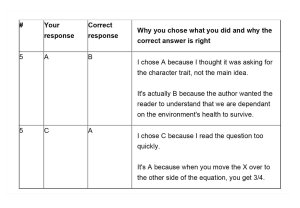
| # | Your response |
Correct response | Why you chose what you did and why the correct answer is right |
| 5 | A | B | I chose A because I thought it was asking for the character trait, not the main idea. It's actually B because the author wanted the reader to understand that we are dependant on the environment's health to survive. |
| 5 | C | A | I chose C because I read the question too quickly. It's A because when you move the X over to the other side of the equation, you get 3/4. |
5. Goal-setting Statement – This can be anything from an index card to a more formal writing piece. What are their goals for next time? Are they going to work harder to show understanding of a certain standard or are they setting a percentage goal for themselves in how they will improve from Below to Proficient by moving up 10% in their correct responses?
6. Data Displays – In order to incorporate a non-linguistic element into their Formative Assessment folders, students should create a visual graph of their own progress from test to test in order to analyze their growth or lack thereof. Additionally, you can have the students graph the data that represents their class as a whole group based on the data from 1st to 4th quarter. Cover the classroom in graphs that show both individual and class-wide growth.
By the end of the year, through analyzing their own data, goal setting, and reflecting, more students will improve. I’ve seen it. Using data formatively is vital for students because it gives them control in their own learning, and in the end, less information will find its way into the cranium’s trash.
Heather's book is available at the Web site Eye on Eye Education Publishing and on Amazon.
Comments (24)
Comment RSSSign in or register to post comments
I teach 7th grade math and
I teach 7th grade math and always ask students to defend their answers by showing their work even if they have a multiple choice question. I think the idea of giving them the questions first and then the multiple choice answers later is great. I give formative assessments prior to my summative assessment (which includes some multiple choice) would you include some multiple choice questions on the formative assessments to align the formatives with the summatives?
Multiple Choice as Formative
I love the idea of using it as a guide to start learning vs. ending the learning. We all know that multiple choice questions often aren't the best way to assess students because of the guessing factor. I like how you have chosen to use it to pre-assess the students to find out what they know and also as a means to set goals for what they will be learning by having them reflect on how they took the test. My school uses standards based grading and I often feel the need for short answer/essay questions to assess the students when in the past I used a lot of multiple choice questions. I still find myself wanting to use them for simple 'do they know it or not' type questions but I think your idea during the start of the learning is more of a useful tool.
I really like the idea of
I really like the idea of using multiple choice tests for formative assessment. Using the data to differentiate and drive instruction is a wonderful way to hold students accountable.
Do you feel that you can gain a deep understanding of what your students really know/comprehend? Or do you feel there is the factor of elimination and guessing that makes multiple choice tests not as strong of an indicator of student knowledge as a short answer or fill in the blank type test?
Assessments and Goal-Setting
When reviewing summative multiple-choice assessments, the challenge I faced was how to engage all students (from perfect scores to not passing) during the review process. To start, I place the score from the scantron on the test, yet no problems are marked wrong. After analyzing the test data, I formally review a few of the “most missed” questions for that specific period. Students follow along and when they notice a difference in their work, they rework the problem in pen on the test.
Once these problems are reviewed whole class, we correct the test and compare our packet score to the scantron score. Much discussion and reflection takes place when these two scores don’t match. Finally, each student is given a “How to Solve,” which is a worked out test. Each student works at their own pace on the specific problems missed and reworks the problem in pen on the test.
To conclude the review activity, each student works on their Goal Tracking Sheet. Students identify one or two topics of strength and just one topic that needs improvement. Finally, students set a goal for the next assessment.
After taking the next test, students review their area that needed improvement and reflect upon their growth. They also reflect on the variety of reasons they did or did not reach their test score goal.
Last year when my students completed their “Exit Interview,” all students wrote that the “How to Solve” and Goal Tracking activities were very helpful and supported their learning.
I like it!
As a department we have tried to stay away from multiple choice assessments because our students seem to answer quickly and with less care because they know "one of them has to be right."
I like the idea of having the kids go through and explain what they did wrong on each problem - but I wonder, is this something you have them do in class? Is this their "homework"? How (or do you at all) address cheating when they are going through and correcting mistakes? I could see them sharing answers and writing what other kids say they did wrong instead of being mindful of their own mistakes... And finally, is this something you grade? If so, how?
Love it!
I don't use a lot of multiple choice tests in my classroom, but when I do, I am always frustrated by the kids who "learn it for the test" and then don't know it the next week. I think this is a great idea that I would like to borrow. It will also be immensely helpful at conferences - we have student led conferences and I'm always at a loss of what to put into a folder from a music class. I am excited to try this with my next unit test!
In bringing the students into
In bringing the students into the assessment in a way that causes them to become responsible for their own learning you are achieving a monumental assessment task according to AFL advocates (myself among them). When the child is so directly included in the assessment process they learn to focus on the guiding principles of formative assmnt- Where am I going? Where am I now? How will I close the gap? Good for you!!! May I "borrow" your ideas? P.S. Have you tried including students in a parent conference, letting them explain their learning and goals?
Great Idea
I love your idea of using the short answer packet after multiple choice assessments. I don't really like giving multiple choice assessments but I feel like I have to since so many standardized, high stakes tests are given as multiple choice. I don't know why I haven't considered a strategy that asks students to explain their choice before, I think it's great. Thanks for sharing it. Do you ever give formative assessments before the multiple choice test? If so, do you grade them?
What a great way to use
What a great way to use multiple choice tests! I teach third grade so I like to use multiple choice tests but I always want to do more with them. This is a creative way to make it a formative assessment. I can now still use my multiple choice questions and make my students think about their answers. Thanks!
Great idea. It really upsets
Great idea. It really upsets me when students throw away all of their graded tests and assignments. My students will look for the mistakes they made on a returned assignment. They even will ask why a particular answer is incorrect. Unfortunately, however, by the end of the class period, the papers end up in the recycling bin. I think your "lesson trail" exercise could be useful for improving student achievement and for allowing extended learning opportunities. Thanks for sharing.