Assessment Subscribe to RSS
How Can We Make Assessments Meaningful?
July 31, 2012 | Heather Wolpert-G...I think meaningful assessments can come in many shapes and sizes. It fact, to be thoroughly engaging and to draw the best work out of the students, assessments should come in different formats.
Thankfully, with the Common Core standards exemplifying the 4Cs: Creativity and Critical Thinking (through performance-based assessments), Collaboration, and Communication (in particular through the use of interdisciplinary writing), we are looking at a more fluid future in testing formats. As long as the format itself is aligned with real-world skills, a meaningful assessment does not need to be lock step with a particular structure anymore.
When I think about my own definition of a "meaningful assessment," I think the test must meet certain requirements. The assessment must have value other than "because it's on the test." It has value to the individual student who is taking it. It must intend to impact the world beyond the student "self," whether it is on the school site, the outlying community, the state, country, world, etc. And finally, the assessment should incorporate skills that students need for their future. That is, the test must assess skills other than the mere content. It must also test how eloquent the students communicate their content.
Criteria for a Meaningful Classroom Assessment
To address these requirements, I ask myself the following guided questions:
- Does the assessment involve project-based learning?
- Does it allow for student choice of topics?
- Is it inquiry based?
- Does it ask that students use some level of internet literacy to find their answers?
- Does it involve independent problem solving?
- Does it incorporate the 4Cs?
- Do the students need to communicate their knowledge via writing in some way?
- Does the final draft or project require other modalities in its presentation? (visual, oral, data, etc...)
Clearly not all assessments achieve every single characteristic listed above. But in our attempt to address some of these elements, we will have made our classroom assessments so much more meaningful.
Because it's vital that a student connect with the value of their assessments. After all, if a student trusts that the assessment is meaningful and will help them later on, it helps with both their achievement and with your own classroom management.
Transparency in Why It's Important
That requires taking the effort to inform the students why the assessment has value. Some teachers still balk at this job, as if students should just trust that what we do in school has value to what happens outside of school. However, kids are smart these days. They know that bubbling with a #2 pencil is antiquated. They know that much of the content we teach them can be found via Google if they were so inclined. But as savvy as students are, they don't know everything about communicating their content, and we owe it to them to make sure that not only are our tests aligned with skills they must know for their future, but to make sure that we've been transparent in our rationale.
So how can high-stakes assessments be meaningful to students? For one thing, high-stakes tests shouldn't be so high-stakes. It's inauthentic. They should and still can be a mere snapshot of ability. Additionally, those occasional assessments need to take a back seat to the real learning and achievement going on in every day assessments observed by the teacher.
The key here, however, is to assess everyday. Not in boring, multiple-choice daily quizzes, but in informal, engaging assessments that take more than just a snapshot of a student's knowledge at one moment in time.
But frankly, any assessment that sounds cool can still be made meaningless. It's how the students interact with the test that makes it meaningful. Remember the 4 Cs and ask this: does the assessment allow for:
Creativity Are they students creating or just regurgitating? Are they being given credit for presenting something other than what was described?
Collaboration Have they spent some time working with others to formulate their thoughts, brainstorm, or seek feedback from peers?
Critical Thinking Are the students doing more work than the teacher in seeking out information and problem solving?
Communication Does the assessment emphasize the need to communicate the content well? Is there writing involved as well as other modalities? If asked to teach the content to other students, what methods will the student use to communicate the information and help embed it more deeply?
Rubric on Meaningful Assessments
So as an activity for myself, I created a rubric to look at whenever I was wondering if an assessment was going to be a waste of time or was going to connect with the students. (Click the chart to download the PDF.)
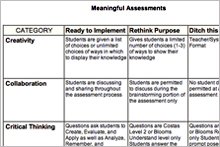
Click to download the PDF of this chart. (275 KB)
Credit: Heather Wolpert-Gawron
Another way to ensure that an assessment is meaningful, of course, is to simply ask the students what they thought. Design a survey after each major unit or assessment. Or, better yet, if you want to encourage students to really focus on the requirements on a rubric, add a row that's only for them to fill out for you. That way, the rubric's feedback is more of a give-and-take, and you get feedback on the assessment's level of meaningfulness as soon as possible.
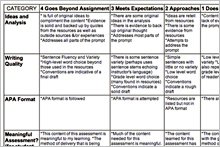
Click to download the PDF of this chart. (209 KB)
Credit: Heather Wolpert-Gawron
Download the example (left) of a quick rubric I designed for a general writing assessment. I included a row that the participants could fill out that actually gave me quick feedback on how meaningful or helpful they believed the assessment was towards their own learning. As an instructor and lesson designer, I want a quick turnaround between when I assign an assessment and if I need to adjust the assessment to meet the needs of future learners. By also giving them a space to fill out, they own the rubric even more, and will pay more attention to what I fill out knowing that I gave them an opportunity to also give me feedback. It's one way the students and I can learn reciprocally.
So how do you ensure that your classroom assessments are meaningful?


Comments (55)
Comment RSSSign in or register to post comments
I really enjoyed reading your
I really enjoyed reading your personal views on meaningful assessments. I think it is so difficult to create meaningful assessments and I liked your ideas that you have. I think the example of the rubric was particularly helpful when thinking about how to assess if an assignment or task was meaningful. I plan on using it as a reference throughout my year and assignment planning. I also like how you survey your students and get their feedback. I think that is incredibly valuable. I look forward to sharing the 4C's with my colleagues this fall.
In my experience, I have
In my experience, I have found that most of the assessing I do in my classroom is informal. We do take math test directly from our curriculum, but I have been very unhappy with those. I have wanted to make changes to those tests and am finally doing that this year. It is so important to know that the assessments you give students are truly giving you the information you need about their learning. I do love rubrics and have been trying to use those more often with my first graders. They love to know what they need to include in a writing assignment and love the responsibility of checking to make sure they included it. I really like the idea of asking the students to assess the assessment. I think it gives them some responsibilty in making sure the assessment is appropriate. I am so glad there is so much information out there to help. Thank you for the article and the great information.
THE BEST ASSESSMENT ...
... the words you choose when you personally meet with a parent in describing their child at school. The power of what you say can alter the future.
www.adixiediary.com
Good ideas!
I like the idea of using a checklist when designing assessments, and I think incorporating the four C's not only benefits the students but it benefits us teachers as well. It validates our assessments and gives them a sense of meaningful purpose. So to often students do not have much of a say in their learning and I think this really turns them off and gives them a negative attitude about school. Focusing the assessments on skills students must use in their future helps them tremendously as they get older. You're right - students can look up facts on google anytime. Heck, teachers use google all the time to look up facts. And I think you nailed it on the head - how can we get our students communicate the content in a way that is meaningful to them? That is where you checklists/rubrics come in to play. Great article. Thanks for posting it.
Assessments
Having rubrics is so important for student success! I didn't learn that until a few months into my first year of teaching, and once I started using rubrics I was amazed by the success of my students. My district has a very intense rubric for grading writing, which can be overwhelming to students. Many students get it back, and search for a grade (1, 2, 3 or 4) and don't understand that they are graded in each strand. I realized there was this gap, and taught my students the rubric and then had them practice on anchor papers. I was amazed how much harder they were on the anchor papers than the district was. Once they were confident in grading other papers, I had them start grading themselves. I would have them grade themselves in yellow, and I would grade them on the same rubric in blue. The things we agreed on then turned green, and then students could see if they were too hard on themselves or too easy. Students loved seeing how well they did, and then they understood what they needed to do to truly improve their writing.
My district implements a
My district implements a curriculum in which most assessment is informal. We use informal observations, portfolios, and running records to track the academic growth of our students. When it comes time to take the standardized tests, our students freeze up because they are not experienced in taking these types of assessments. Because of this, they tend to not do well on state tests. We have recently adopted the CCSS and I look forward to using these standards to guide my instruction. Along with these standards, I will develop assessments that will help me to monitor student growth.
Assessments
I am currently working on my Master's and found this post about assessments very informative. Using a rubric for students no matter their age is very beneficial. My oldest son was in 6th grade last school year and his communication arts teacher used rubrics in the grading of their papers. As a parent I found this helpful when helping him with his homework since it let us know exactly what she was looking for. Now that I am back in school I find it helpful for myself since my instructor uses a rubric for assessment. I learned that I need to follow the 4C's, creativity, collaboration, critical thinking, and communication, when creating assessments.
I really enjoyed your points
I really enjoyed your points on meaningful assessments. You are right about students being able to bubble in with a #2 pencil, yet that doesn't really show us what they know. Nor does it really show us the student's overall growth.
I like to use rubrics myself, because then the kids know right up front what is expected of them and they can "choose" their grade. I had never thought about letting them pick some of the items that are on the rubric. I like the idea that it gives them ownership of the assignment themselves.
As others have said not every student does well with standardized and formal tests, but that doesn't necessarily mean that they don't know the material. By giving them informal assessments-observations, discussions, etc, you can actually see what they have learned.
When I was a student what I remember the most where the class projects, the hands-on activities and the units. I don't remember the things that were on the tests.
Thanks for including the 8 questions that you use to set up your criteria.
Wonderful article.
By not allowing yourself to have non-meaningful assessments, you are truly raising the bar. Every assessment should have to pass this test. It's too bad that standardized testing practices have not caught up with authentic learning experiences. Technology is leading the way toward more meaningful assessment experiences for students that will someday take these experiences from classrooms like yours to an overall strategy for all educational assessment. Thank you.
This is an excellent Post. I
This is an excellent Post. I think using a rubric and having the students knowing the expectations of the various levels of performance is critical. Therefore students/learners should be able to make their own self-assessment. Assessment should always make sense to the learner/students, authentic and have significant value. Also it must be a reliable and valid tool that is free from subjectivity.