Assessment Subscribe to RSS
Assessing the Common Core Standards: Real Life Mathematics
June 28, 2011 | Andrew MillerAnother buzzword that permeates the conversation around education is relevancy, and rightfully so. We want our students not only to make connections to real world problems but also to do these activities.
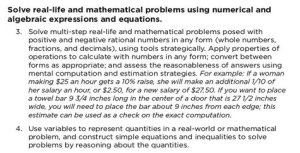
However, it is not simply in the task that we want students to mimic this real world connection. Students are already conditioned to do this. They are used to sitting and completing tasks. Even when the task might have great connection to the real world, it can still just be that: a task to complete. We need to keep this in mind when we ask students to perform real world math, just as the Math Common Core dictates. This common core standard below gives a great example and sets a good tone for what can be target for math instruction.

In a previous blog discussing Math PBL Project Design, I wrote about reframing the word "problem," and pointed to this standard. For many of us, there is a very traditional meaning that is activated: a word problem in the text book, or simply a calculation to be made. In fact, the Common Core gives it as an example.
We can do better. We can assess learning in a much more relevant and engaging way. For instance, how do we assess this common core standard related to area and volume?
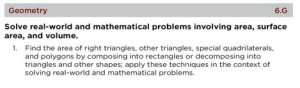
This standard is much less specific about what this might "look like" in the classroom, which leaves it ripe for innovation. There are a variety of products and contexts that could assess this standard. The major assessment, or culminating product in PBL terms, could take on the form of a podcast, presentation, marketing plan, or even a short story.
Perhaps high school students are creating a pool that can meet the needs of ALL people who want to use, from those who have special needs, to children, but at the same time needs to meet certain criteria is terms of standard amounts of water and size.
Perhaps middle school students are in charge of design a new and improved pyramid to be presented to the pharaoh, complete with a variety of antechambers.
Perhaps elementary students are in charge of creating an organic garden to sell certain products at the local farmer's market.
(A word of caution, don't give students the exact criteria, instead make them research and make decisions on what the criteria should be.) Again the genre is not as important as the rubric that demands specific criteria. As long as the rubric is clear and transparent where students must demonstrate math skills, include examples, etc, then we know that students are in fact learning the content standard, or common core standard. If you as the teacher need a specific graph, then make sure to include in the rubric. If you need written explanation around the mathematical calculations, then demand it. If you need diagrams and measurements, then make sure the rubric demands it. Grading is not a surprise anymore. It is clear and transparent.
When looking at the potential for work with this Math Common core, make sure you have high expectations for the level of work your students can do. The old definition of the word "problem" is not rigorous. Redefining the word "problem" within the frame of Problem or Project-Based Learning is rigorous, and still demands real world connections in an authentic way. If we want our students to really wrestle with math concepts, then we must create space for this work to happen, and create assessments that mirror this complex work.


Comments (22)
Comment RSSSign in or register to post comments
More Free Resources
I think the best part of having a set of standards for everyone is that everyone can contribute to the education of ALL of our students! Check out http://on.fb.me/ccssmainmenu which is a collection of Facebook "fan pages" categorized by subject and grade level. These 96 fan pages organize free resources (videos, lesson plans, curriculum maps, crosswalks) to help teachers and parents teach their students the standards! Just hit the "Wall" tab to start your journey!
Books on math aligned to common core
We have several math and financial literacy chapter books that are aligned with common core and do a good job making math relevant (elementary/middle school level). You can read sample pages of any of these books on our website. Here are a few:
Sports & Math: http://www.pacificlearning.com/p-4893-its-a-numbers-game.aspx
Poetry & Math: http://www.pacificlearning.com/p-4891-the-right-angle.aspx
Personal finance & Math: http://www.pacificlearning.com/p-4890-money-doesnt-grown-on-trees.aspx
I really like the idea of PBL
I really like the idea of PBL in the math classroom. I am trying vary hard to incorporate this learning into my classroom with creative and motivating lessons. My question is what sort of summative assessments should be used besides just paper pencil tests over the material. I have a few lessons where I do the PBL approach and the students seem to respond very well. I agree that with the use of technology in today's soctiety, we really need these sorts of lessons anyways.
I am a fan of well-thought
I am a fan of well-thought out PBL approaches to learning Math. Instead of asking students to rely on memorizing formulas by rote, it encourages our students to find creative application of the learned abstract concepts. In our times where technology is king, I find PBL learning a timely and responsive notion.
Sacha
http://luria-learning.blogspot.com
Organization
Andrew thank you for the encouragement! I have been to www.bie.org and now have the site on my favorites bar. I am looking at a few of the beginner projects.
My next question is, how do you decide to plan the semester to make sure I have lessons planned to meet all the objectives and goals? I am so trained in common or related topics are organized together in units and I am noticing this old organization is not going to work. I want to let go of the old units and order of topics but am uncertain as how to accomplish the change? I hope my question is clear? Any advice would be greatly appreciated.
I am currently revising the beginning of the semester. The geometry class will now be reading Flatland to learn all the basic vocabulary usually taught in the first couple of units. It is still a work in progress.
Thank you,
Joanne
@MRM - Exactly, and of course
@MRM - Exactly, and of course to solve these real world problems, they will need to practice some math problems, whether that is in text books or worksheets. The difference is that the students will see the NEED to practice; to be successful in an authentic project
@Joanne - It sounds like you are really doing a great job giving Math PBL a shot. I hear your concern about students saying "tell me what to do." Its a paradigm shift, so of course there will be resistance. Keep pushing, as I know you want to build independent learners and critical thinkers. Remember to scaffold that exploration and "doing work" process with them. They will especially need it if they are student starting PBL and learning to become a PBL learner.
As far as examples, visit www.bie.org and look at the Project Search feature. Free project examples. Also feel free to post in the forum or keep asking me questions. I'm here to help
@Romualdas - Thank you for the resource. I know people will find it useful!
@Susan - I'm glad you found
@Susan - I'm glad you found this affirmative. Thank you for the comment!
@PK - I do agree that students need to do those sort of problems. In fact, in a PBL project like the ones mentioned, students will still do those traditional lessons, activities, etc. The difference is that there is a direct connection to the project. I tell teachers to always use their bag of tricks because they can always help students learn. The problems you mention might be scaffolding to support them to perform this authentic project.
This is why I am excited for
This is why I am excited for the common core standards! They leave a lot of room for creativity, connections to other subject areas, and ways to build personal meaning rather than just a script. I know this can be scary to a lot of teachers - we are so used to the culture of "teach to the test" at this point, but I am confident that once we allow our teachers to be creative in how they teach these core standards, it will reignite their passion for their profession.
Call me old school, I do not
Call me old school, I do not agree with a pure PBL approach. There is nothing wrong with abstract thinking and learning. A "non real world math problem" IS a problem to be solved. Is a made up salary computation problem more "real" than a abstract algebra problem? I am not sure. By all means mix the two approaches. But to say that kids can only learn if it "feel real" is not giving young minds credit.
Help with creating authentic real-world products.
I was committed to making changes in my geometry classroom during the past school year and I certainly had a lot of ups and downs! I focused on creating a student-centered learning environment rather than teacher-centered.
Instead of giving paper-and-pencil assessments for the last few topics I created a rubric requiring students to create a digital product. As you suggested in your post I did not tell them what their product needed to look like, but did tell them what they were required to include in their work such as at least 3 different geometric figures one of which needed to be a regular polygon with more than four sides and to provide calculations for determining the geometric probability of landing within a certain area. The rubric clearly stated what they needed to incorporate into their product to earn a perfect score.
Since this was the first time I assigned this assessment I did not have any exemplars but many of the groups produced some very interesting products. They were understandably concerned about how they were going to be graded because they had not been asked to do anything like this in any of their previous math classes.
Some students were very needy and kept trying to get me to "tell" them what I wanted them to do, they did not like the lack of structure since they were not given step-by-step directions.
The one aspect I could not find a way to incorporate into this assessment was an authentic real world connection. Do you have any suggestions for an authentic real-world product incorporating geometric probability for area or volume, that is something other than concentric circles?