Stop Blocking Online Content
Severely limiting Internet access does high school students a disservice.
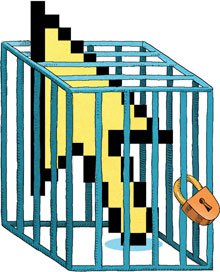
by Jon-Michael Poff

Credit: Wesley Bedrosian
The blocking problem started back in August 2007. Each time desktop-publishing students tried to access images, they were blocked. When my English teacher, Lisa Huff (profiled in this Edutopia.org article), needed to get to information from Flickr and the document-sharing site Scribd, she was blocked. My classmate Megan Holifield wanted to watch a news clip on YouTube for inspiration in producing her own broadcast, and she was blocked.
Instead of embracing technology as twenty-first-century schools should, the Batesville, Arkansas, schools -- along with many others -- have been turning on the firewalls, preventing students from realizing the full opportunity the Internet offers.
Students and teachers need online tools to create projects, dispense information, and deepen their understanding of the subject matter. After more than a year of imposing a strict blockade, it's high time for the Batesville schools to bulldoze the firewalls and let the light of the Internet shine on students and teachers.
Last fall, a classmate at Batesville High School told me he spent forty minutes trying to access his school-assigned blog, one our English teacher graded regularly. Another classmate said she couldn't get to the images she needed for her desktop-publishing class; she had to download them at home. (Luckily for her, her family owns a computer.)
Not only is this blockade frustrating, it's also hindering our prospects as college- and work-ready students. In a multimedia world, it is essential that students leave high school with a deep knowledge of digital tools. Blogs are not only a cool way to publish your opinions, they are also the future of social and business networking. RSS reader sites like Google Reader enable users to sort and consume massive amounts of information efficiently. The use of photo sites is vital to creating multimedia projects.
District administrators and technicians have been aware of the problem since we voiced our concerns back in September 2007. Last year, I confronted a technician who was remotely accessing my computer about the growing problem of blocked Web sites. He told me that was just too bad -- some things we can't change.
Well, some things we can change. Some things we must change. As of this fall, it seems our district is beginning to grasp the need to equip students with up-to-date technology skills -- our blogs, Flickr, and TeacherTube are now unblocked. But there's still a long way to go.
To be fair, it's not just administrators and technicians who control the Internet at our school. The federal Children's Internet Protection Act states that schools and libraries may not receive the E-rate discount on communications technology unless they have technology protections and an Internet-safety policy. Such policies, according to CIPA, must include measures "to block or filter Internet access to pictures that: (a) are obscene, (b) are child pornography, or (c) are harmful to minors." My blog includes (d) none of the above. Neither does the information Mrs. Huff needed to access, nor does Megan's video.
Of course, the Internet does include some inappropriate material that school technicians need to block. However, blocking educational sites along with the nasty ones is not the solution. Clearly, we need a better, more efficient filter -- one that allows for unhindered educational use while also preventing twelve-year-olds from viewing pornography.
Beyond filters, there lies a fundamental issue of trust. Where is the district's trust in well-meaning, hardworking students when their Internet access is limited to the school home page and CNN?
Think back to when your parents first let you start driving. In the back of their minds was the knowledge that you might ding a door, hit a pole, or even smash into another car. However, they eventually realized they couldn't hold your hand forever; they had to let you drive by yourself. In the same way, districts must loosen the reins and let students "drive" by themselves. And, just as parents teach their teens how to make a left turn on a busy street, schools must mentor students so that they learn to navigate the information superhighway for themselves.
How much longer will schools compromise students' education? To those who have the responsibility to make a change, hear our cry: Tear down that wall.

Credit: Wesley Bedrosian
Jon-Michael Poff is a senior at Batesville High School, in Batesville, Arkansas.
This article was also published in the Dec/Jan 2008: Collaboration issue of Edutopia magazine .
Advertisement
Latest Blog Posts

A Classroom Canvas that Encourages Community
by Gaetan Pappalardo
Third-grade teacher, writer, and musician
Posted September 3, 2010, 11:13 am CDT

The Future of Teacher Prep Programs, Part Three
by Heather Wolpert-Gawron
Teacher at a middle school in San Gabriel, CA
Posted September 2, 2010, 10:24 am CDT

The Importance of Student Journals and How to Respond Efficiently
by Todd Finley
Associate professor of English Ed at East Carolina University
Posted September 1, 2010, 6:49 pm CDT

Introducing the First #scichat Challenge
by Eric Brunsell
STEM educator
Posted August 31, 2010, 5:28 pm CDT

The Shallop Project: A Summer Learning Adventure
by Suzie Boss
Writer about sustainability and project learning
Posted August 30, 2010, 5:58 pm CDT

Technology Tools for the First Week of School
by Mary Beth Hertz
Elementary school computer teacher
Posted August 30, 2010, 3:04 pm CDT

Social and Emotional Learning and the Start of School
by Maurice Elias
Director of the Social-Emotional Learning Lab at Rutgers
Posted August 27, 2010, 10:25 am CDT
Sign Up for Our Free Weekly E-newsletter!
Advertisement

Comments
Filters
I concur Jon_Michael, filters are bad. You may get a kick out of an article I wrote ten years ago about filtering, the scourge of education: Filtering is Bad for Education written for Technology & Learning.
http://tnellen.com/ted/filter.html I'd love to see a publication like Edutopia do a comprehensive report on filtering in our schools. Who controls and determines what is filtered? That is a well kept secret.
What is ironic is that students use proxies to bypass school filters to access whatever they want. Teachers are restricted in their classes from accessing good educational stuff, while students access the inappropriate stuff the filter is supposed to block.
Once again adults think they know better and may be acting in good faith, but are not successful and continue to do the wrong thing. Much has to be reviewed about the filters and how the technology is not being used effectively in schools. In addition consider that these filters do not exist at home with the result that students are not learning to use the technology correctly or safely because we are hamstrung in our schools.
Cheers,
Ted
Technology In Class
I run into this problem on an almost daiy basis. I work with teachers to incorporate technology into their classrooms - from laptops and LCDs to SchoolPads and TurningPoint, document cameras and more. I also create resource web pages for our teachers and am often stymied by blocks - try searching for information on "oral presentations." The word oral is automatically blocked, along with teen, mp3, lyric, and plenty more.
I understand the position administrators are in faced with CIPA, but I also know the frustration of the filters. I should not have to do my work at home. I can't get my home email at work, why should I have to view and download resources at home?
As you said, at some point we need to trust students. Yeah, some of them are going to mess up - let them suffer the consequences. Why should everyone else suffer? I am also a firm believer that teachers need to be aware of what their students are doing on the computers in their rooms and in the labs. Students should be on the computers with a purpose, not simply free time.
The state of Virginia requires all teachers to teach at least one Internet safety lesson each year. How can we teach students how to safely use MySpace, Facebook, YouTube, etc. if they are blocked? You can only go so far with screen shots (made at home).
You can't teach responsibility if you don't allow students some trust.
CIPA is meant to prevent children for accessing potentially harmful material. However, many schools operate on limited internet bandwidth, necessary for daily operations, and block sites such as Youtube, or other games/entertainment sites because students waste so much bandwidth that the school needs. As a computer instructor, I hate the fact that my students cannot access some sites they need to do their work, and am constantly in touch requesting that sites be unblocked. Sometimes successful, sometimes not. To be fair to the schools, students who do have access are not using the schools' resources as they were meant to be used. I've had to stop illegal downloading of music and videos, students messaging each other with test information, or watching videos and playing games when they should be working on school projects. Classroom management alone does not handle these problems. I would hope that most schools adopt the attitude that if the teacher requests it to be unblocked, they then unblock it. It would be an ideal world if students had 100% access to everything they needed, but unfortunately that also gives them 100% access to what they don't need. And with the rising costs of simply running a school, and the school's increased need for bandwidth for just to manage, or operate PSEO classes, or run Internet software for certain classes, I for one just selfish enough to say - block it unless I need it, as I do not want my students to suffer lack of bandwidth when they need to access their online curriculum, so that other students can play their games.
Filters in Schools
I'm the web manager for a school district, and in principle I'm anti-filter as well, but in practice I simply can't be. There are laws in place in our state, and as long as CIPA is in effect, we simply can't give students unrestricted access to the web. The problem is deeper, though. We started filtering BEFORE teaching students proper, safe, responsible Internet usage, and as a result have created a unique cultural phenomenon. We've driven free-access Internet usage underground in schools (as if students aren't smart enough to use proxies, or just pull up the blocked web sites on their cell phones and bypass the filters entirely). It would take a lot of time to undo this mindset among students, that accessing inappropriate content on the web in a school is "edgy" or "cool." This is why such a solution won't present itself overnight (although I don't think anyone is claiming it will). And as Melissa mentioned, how are we supposed to demonstrate how to use certain sites safely if we can't even gain access to them?
Moreover, there are a LOT of parents out there who are simply anti-Internet. Many of them see absolutely no reason why students should even HAVE Internet access in a school, and will even actively complain to the school administration and try to get it banned. The problem is in the end, it's not a school administrator we report to, and it's not really the students we have to appease...it's the parents. And they are the ones voting for the legislators who make our laws, and who are putting their students in the school system and expecting us to keep them "safe"...how THEY define safety is different from how you or I may define it.
So what can you do? Work with the teachers, staff, AND your parents to try to loosen the bands, and open the dialogue. One thing I would love to see in my own district is a technology-oriented consortium of teachers, administrators, parents, and students. Something beyond just the PTA, and something which can produce actual results and positive change for a school district as a whole.
filtering
This is such a 'hot button' for myself. I am the single mom of two teens, ages 14 and 15. I knew to put restrictions on my son's computer. My daughter...I left it for some time. We had a certain degree of trust between us. But now, I am rethinking things. Shouldn't there be some degree of filtering on my daughter's laptop? She is 14 now, and changing before my eyes. I do not want to block images that may help her with schoolwork, but I am concerned about her exposure rate.
Kathi in VT
Good teacing is key
Just like any other topic I cover in my classroom, it boils down to teaching the students what is acceptable and what is not. I teach my students how to handle a paperback novel so that it lasts more than a year. I teach them my policy on using the bathroom during class time. I teach them what appropriate topics are for writing assignments.
I also teach them what is appropriate on the internet. First, I send a letter home explaining what we'll be doing online and have parents sign a media release saying that it's okay. Then I teach the students what is appropriate. I bought my own domain name so that students go to that site and then link to everything they need. No need for extra "stuff," good or bad. Those don't follow the expectations, lose the opportunity. Just like the kid who throws the paperback book across the room. You don't get the book and your can do a different assignment.
The problem is that not all teachers are doing what we are by teaching and modeling appropriate use. Then, in a large district, things get blocked because teachers aren't being good teachers.
I understand the bandwidth issue. However, if your students know not to be listening to music or watching videos in the background, this isn't an issue. I link to videos on teachertube and google video that are relevant to the lesson. That should be allowed and encouraged.
Enough ranting. Great article and comments!
Blocking
If a student looks up inappropriate material at home, no one is going to sue the parents. If he/she does it at school, someone COULD sue the school. In a perfect world I'm all for unblocking but 1 teacher can't see what 25 students are doing all at once and it's unreasonable to expect them to do so.
When is it too much?
I contacted our district regarding the blocking policy last year and got the CIPA answer. The interesting thing is that there is no official CIPA list. We are only required to have some sort of system in place, leaving many sites up to discussion. I know that some CIPA approved districts have things like youtube unblocked and some (many) do block them. One non-official list I found our district using came from an ultra-conservative christian group. It is very ambiguous what really is needed for CIPA compliance, but I think many paranoid tech admins overkill with their lists.
Further probing revealed that a huge chunk of the block list comes from teachers complaining that their students were "distracted" by these sites. I understand blocking inappropriate material, but there reaches a point when it is the teacher's responsibility to engage and monitor their students. There will always be some site that may distract and taint their minds. What we really need is more internet safety given to them and the ability to show them how to use many of these blocked site responsibly.
just my two bits,
david
Seeing what students are doing
I'm lucky enough to work at a school that recently remodeled the space for the computer lab. It is arranged in tiers, so that the computers are behind the students when they face the front of the classroom. That means that when the teacher is talking and teaching the students are NOT facing their monitors. It also means when they are working on their computers, the teacher can see all the monitors in the room. It's great not only for keeping students on task, but it helps the teacher identify which students need help a bit more quickly as well.
That is a very good point, but why can't we just put in a filter that just blocks all the obscene material and allows the helpful sites?