Lesson 6: Making Your Lessons Stick from Citizen Schools
Help with gauging your students’ knowledge retention.
Download Lesson 6 (144KB)
Hopefully, after reading through this tutorial, you've come away with some learning techniques and even hard lesson plans that will enrapture your students and help them develop their WOW!, or end product. For you the mentor, a WOW! gives a tangible representation of things you've taught through the apprenticeship. In other words, it lets you assess whether or not your lessons have stuck.
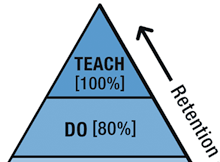
Assessing what students have retained is important to all educational programs. Citizen Schools uses something called the learning triangle to give a visual representation of the path to retention. Moving from the base of the triangle to the top, this model shows that students retain the most and the deepest knowledge when they hear something, see it, discuss it, do it, and teach it back to someone else. Students who progress to the pinnacle of the triangle are often the ones who have absorbed the most.
To appreciate the importance of having students teach back, think about something you learned in school, such as the principle of natural selection or the atomic orbital theory. You may have thought you understood the concept until you tried to explain it to someone else. Teaching something out loud exposes all the holes in your knowledge. When you're able to teach back successfully, you've mastered the subject and will usually retain it for a long time.
In essence, the goal of your entire apprenticeship is to have students reach the triangle's peak by preparing them for the WOW!. Keep track of your student's progress so they reach this end goal. During the final session, have students present their project or what they've learned to a larger group or just to one another. This will reveal to you how you did as a teacher, and more important, how the students did as students.
Overview
Lessons
- Overview: Citizen Schools Lessons at a Glance
- After-School Program Essentials
- Creating Lessons for Different Learning Styles
- Tips for Lesson Planning
- Creating Your Lessons from Templates
- How to Manage the Classroom
- Making Your Lessons Stick
- A Glossary of Common Citizen Schools Terms
Articles
- Transforming Student Learning in the After Hours
- A Week in the Life of a Citizen Schools Student
- Third-Party Assessment of Citizen Schools
- Tips and Resources
More on A New Day for Learning: A Deeper Look into Four Full-Time-Learning Programs