Education Trends Subscribe to RSS
New Reasons to Dislike Multiple-Choice Testing
January 23, 2013 | Terry HeickThe multiple-choice problem is becoming a bit of an issue.
While it has been derided by educators for decades as incapable of truly measuring understanding, and while performance on such exams can be noticeably improved simply by learning a few tricks, the multiple choice question may have a larger, less obvious flaw that disrupts the tone of learning itself. This is a tone that is becoming increasingly important in the 21st century as access to information increases, as the updating of information happens more naturally, and as blended and mobile learning environments become more common.
Tone
Learning depends on a rather eccentric mix of procedural and declarative knowledge -- on the process as much as the end product. Students are often as confused by teacher instructions or activity workflow as they are by the content itself. Keep a tally of how often student questions are related to the logistics of the assignment versus the content itself. You might be surprised.
The process of mastering mathematics, for example, is served as much by a consistent process of practice as it is the practice itself. If learning is the result of acquiring "new data" and organically folding it into "old data," how students come to that new data is incredibly important. They are best served by a short, taut the line between student and content-to-be-mastered. Even the transparency and apparent relevance of a classroom activity factor into the "value" of a learning experience as much as how cleanly that activity aligns with an academic standard.
This all emphasizes the value of uncertainty in learning.
Uncertainty
There is nothing wrong with being uncertain.
In fact, it has often been said that the more a person learns, the less they're ever sure of. This shouldn't mean that students always lack confidence, but rather the opposite: that all stakeholders in education clarify that learning is a messy process chock-full of uncertainty, iteration and revision, and that anything tidy stemming from this untidy process should be questioned.
This shines a spotlight on multiple-choice questions, and not purely as an attack on them. There have been enough studies done to show that a well-written multiple-choice question actually measures understanding fairly well. But in the 21st century, change is happening at an incredible pace. Access to information is disrupting traditional processes and their related mechanisms.
Printed texts have gone from being the final word to simply one step in an endless chain of making information public. Texts are now merged with moving images, hyperlinked, designed to be absorbed into social media habits, and endlessly fluid. From an essay to a blog post, an annotated YouTube video to a STEAM-based video game, a tweet to digital poetry, the seeking and sharing of ideas is an elegant kind of chaos.
As a result, media are more dynamic than ever before -- and thus a bit "uncertain" themselves.
Beyond Either/Or
But the real issue here isn't one of assessment design as much as it is looking at the overall tone of learning.
In the 21st century, networks are a kind of collective wisdom -- or at least they can be. How you connect with others automatically informs how you'll connect with their ideas. If digital interdependence doesn't completely change both sociology and education over the next 25 years, we might need to go back and see what happened.
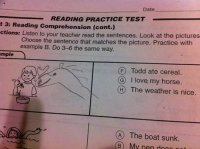
So let us look at multiple-choice questions in this light. More than anything else, when a multiple-choice question is given to a student in hopes of measuring how well he or she understands something, it manufacturers the illusion of right and wrong, a binary condition that ignores the endlessly fluid nature of information.
It alters the tone of learning, shifting it away from a constant process of reconciling old thinking with new data, and toward something of a pitch-and-fetch scenario. One question, four answers, and only one of them is right.
Just point to the right answer.


Comments (28)
Comment RSSSign in or register to post comments
Hi to everybody. I'm Italian
Hi to everybody.
I'm Italian teacher and I'd like to show what's happening in Italian schoolastic system. Here, the multiple choice test is considered a limiting factor and it's not many proposed at students.
We prefer to give test with an "open" answer, 'cause for us it's essential to verify the correctness of subjects and the ability of the way of expressing. I teach subjects as ancient greek, latin, italian literature, history: so, for me, it's necessary that my students learn to ponder, to correlate and one, quick answer for me is useless. Unfortunately, Italian School Departement started with a new national examination, structured by multiple choice test: I think this is a bad deviation and impoverishment of knowledge. Sure, multiple choice test is not absolute evil: it's a convenient tool to prove some precise element. But a big problem here in Italy is the gradual depletion of language (both in lexicon and grammary). Maybe it's better to reinforce this fondamental competence. Sorry for my orrible English.j
MC for science classes
Obviously, MC tests aren't perfect for assessing all kinds of skills, but they can be quite good for testing concrete knowledge and critical thinking especially in science classes. (As an aside, it's a huge mistake to devalue memorized facts. In some subjects the number of facts you need to memorize and hold in your head before you can do any "advanced" problem solving is massive.) The main problem with non-MC tests is that they allow for a great deal of ambiguity, which has its place, but can be terrible for assessment because that ambiguity allows students to talk around an answer they don't really know and introduces huge biases in grading.
Stick to the Topic Dragonswing
Dear Dragonswing,
Just an FYI. When you want to criticize a commenter for "degrading someone," it's probably not wise to begin your reply with a comment that degrades someone. And seriously, in a discussion thread about multiple choice testing you're lamenting the loss of cursive writing and check writing in 2013? Believe me, I'm glad I don't teach your children because parent teacher conferences would be a nightmare.
From your comment, I am glad
From your comment, I am glad my children do not have you as a teacher. Instead of offering some kind of solution, you only degrade someone for their opinion. If you ask me, teaching needs to get back to the basics---like learning to write. It is a shame that today's children are not taught cursive writing. How are they to read documents (as in historical since nowadays I doubt if any are actually written), sign a contract, write a check?
Another problem I see with
Another problem I see with multiple choice testing is that test designers seem to go great lengths to confuse students by offering "wrong" choices as possible answers that have some truth or "correctness" to them. Test-taking then becomes more of a test to recognize wrong information rather than knowing right information. I believe that this circumstance invalidates many such tests, at least to some degree.
Pithy Blog!
My thinking about this subject has been elevated. Just pointing to a right answer is reductive and the wrong message to send in the post-"There are WWMDs" world.
.
Your points are so on target, Terry. And two of them mesh really well to make another one.
You wrote, "There have been enough studies done to show that a well-written multiple-choice question actually measures understanding fairly well."
And, "Texts are now merged with moving images, hyperlinked, designed to be absorbed into social media habits, and endlessly fluid."
These two statements lead me to think: because information is so fluid (getting created fast and by so many) the people who have the SKILLS to properly write multiple-choice questions that will measure understanding are not the same people who ARE writing the questions!
I know that my multiple-choice question writing skills are very poor - and yet I've been hired to do it. Not just in academia, either - in the oil and gas industry where "understanding" can mean the difference between life and death.
I avoid those test questions like the plague. I hope someday they can be as frowned upon as cigarettes. (Which were once cheap and cool - like MC questions are these days!)
Thanks for helping the revolution along!
One last comment to a
One last comment to a spirited discussion, most of it "piling on" about standardized testing. Yes, standardized testing is flawed. As are most of the "best practices" in education. But useful, efficient and easy to score. Should it be the only means of assessment? Of course not. But it is about making choices, and has a degree of validity that seems to escape many of the participants in this discussion. Discard all multiple choice tests? I say NO. Use them with caution. That's all folks!
I love having students show
I love having students show their understanding. It doesn't replace standardized tests but should definitely be considered a form of assessment: http://wp.me/p2qsME-b3
After reading that last
After reading that last response from George Peternel, all I can say is that today's students and teachers are rejoicing that he is a RETIRED principal.