Education Trends Subscribe to RSS
New Reasons to Dislike Multiple-Choice Testing
January 23, 2013 | Terry HeickThe multiple-choice problem is becoming a bit of an issue.
While it has been derided by educators for decades as incapable of truly measuring understanding, and while performance on such exams can be noticeably improved simply by learning a few tricks, the multiple choice question may have a larger, less obvious flaw that disrupts the tone of learning itself. This is a tone that is becoming increasingly important in the 21st century as access to information increases, as the updating of information happens more naturally, and as blended and mobile learning environments become more common.
Tone
Learning depends on a rather eccentric mix of procedural and declarative knowledge -- on the process as much as the end product. Students are often as confused by teacher instructions or activity workflow as they are by the content itself. Keep a tally of how often student questions are related to the logistics of the assignment versus the content itself. You might be surprised.
The process of mastering mathematics, for example, is served as much by a consistent process of practice as it is the practice itself. If learning is the result of acquiring "new data" and organically folding it into "old data," how students come to that new data is incredibly important. They are best served by a short, taut the line between student and content-to-be-mastered. Even the transparency and apparent relevance of a classroom activity factor into the "value" of a learning experience as much as how cleanly that activity aligns with an academic standard.
This all emphasizes the value of uncertainty in learning.
Uncertainty
There is nothing wrong with being uncertain.
In fact, it has often been said that the more a person learns, the less they're ever sure of. This shouldn't mean that students always lack confidence, but rather the opposite: that all stakeholders in education clarify that learning is a messy process chock-full of uncertainty, iteration and revision, and that anything tidy stemming from this untidy process should be questioned.
This shines a spotlight on multiple-choice questions, and not purely as an attack on them. There have been enough studies done to show that a well-written multiple-choice question actually measures understanding fairly well. But in the 21st century, change is happening at an incredible pace. Access to information is disrupting traditional processes and their related mechanisms.
Printed texts have gone from being the final word to simply one step in an endless chain of making information public. Texts are now merged with moving images, hyperlinked, designed to be absorbed into social media habits, and endlessly fluid. From an essay to a blog post, an annotated YouTube video to a STEAM-based video game, a tweet to digital poetry, the seeking and sharing of ideas is an elegant kind of chaos.
As a result, media are more dynamic than ever before -- and thus a bit "uncertain" themselves.
Beyond Either/Or
But the real issue here isn't one of assessment design as much as it is looking at the overall tone of learning.
In the 21st century, networks are a kind of collective wisdom -- or at least they can be. How you connect with others automatically informs how you'll connect with their ideas. If digital interdependence doesn't completely change both sociology and education over the next 25 years, we might need to go back and see what happened.
So let us look at multiple-choice questions in this light. More than anything else, when a multiple-choice question is given to a student in hopes of measuring how well he or she understands something, it manufacturers the illusion of right and wrong, a binary condition that ignores the endlessly fluid nature of information.
It alters the tone of learning, shifting it away from a constant process of reconciling old thinking with new data, and toward something of a pitch-and-fetch scenario. One question, four answers, and only one of them is right.
Just point to the right answer.


Comments (28)
Comment RSSSign in or register to post comments
The problem is not with
The problem is not with multiple choice tests. They have their place in education and are a good way to measure basic information and fact retention. The problem is the use of multiple choice tests. State and federal agencies hold teachers accountable for a student's performance on one measure on one day in the school year. Not appropropriate in any professional venue. It must be remembered that we are talking about student performance--not adult performance and many variables come into play in a child's life during that day that can affect their performance.
Fair Assessment - Maybe the problem is the "Fair" bit
Thanks for the interesting discussion of this always debated, so very American way of asking students to tell us what they know or at least what they understand. To state the obvious, all educators know that learning cannot be measured, hence our ongoing problem around both the form and content of assessments. What we do measure are things that we can measure that we think indicate learning is taking place, or has taken place. The big debate is over which of those things we think do the best job as 'stand-ins' and what's our basis for the claim.
So, is understanding (if that's what multiple choice questions assess) a good stand-in, and is it a complete indicator of learning or should we always be linking it to other things, since learning is the increase of knowledge and knowledge is more than just understanding? Good question, I have a professional opinion, but a very long winded one - just wanted to support those who have already raised this 'what's it testing' question.
Thank you for the great presentation of a question it is time to debate again. One picky point, the research I have seen on multiple choice testing is that it is biased to the male student, female students (according to the research I've seen) do better when asked to show the same level of understanding through matching questions and cloze designed questions (on which male students do less well).
What's the Issue?
There is an inherent uncertainty in learning, and it's something we should value. However, in assessing what has been learned, there should be an absolute measure. A skill has been mastered or not. A piece of information has been retained or not.
And while there are countless ways of attaining and exchanging information, information itself isn't fluid.
This seems to be more about balking at absolutes than it is about an ineffective means of measuring learned information.
Not so fast..
I agree that m/c are over used and abused but that is because teachers haven't always made effective m/c tests. Have you ever taken an AP exam or the GRE exam? They are effective m/c because they are strategically created to inspire thinking. They are not simple fact recall with an easy answer and obvious wrong choices. It takes much thought to create these m/c items that could lead to all answers being plausible but only one correct answer. At younger ages this can be difficult to create but as students get older, effective m/c exams can exist. Give students a m/c test and instead of having them give the right answer, have them explain why the others are wrong and demonstrate how they use their thought processes to eliminate answers, to arrive at the final conclusion. By creating these m/c tests, my students begged for actual written response tests with only one answer to give. It's a different approach but highly effective, because students exams, and choices in life for that matter, come down to eliminating options to choose the best path.
I would have to agree with
I would have to agree with you in most instances. I believe that there are certain things that people should just know and if you're testing for recall of information the a m/c question can certainly be effective. Are they over over used and abused by teachers in the name of expediency? You betcha.
The use of multiple choice
The use of multiple choice tests is based on ease of operation for the teacher. In other words the teacher is lazy. As a math teacher I want my students to be able to understand the problem and properly compute the answer. If I have to supply the answer, I didn't do a good enough job of teaching.
Filling in the Blank
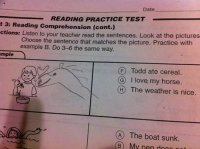
...with the desire of her heart: a horse! Love the illustration. The classic problem with multiple choice ELA type questions is that language reverberates with possibilities. And we also ask students to brainstorm creatively to mine all those possibilities. So, teacher, decide what you want to know!
This article resonants
This article resonants strongly with some of our experiences in The Big-Brained Superheroes Club, as it even pertains to homework (not just testing).
When big-brained superheroes need help on their homework, the problem is almost always in understanding the instructions. Once they get through that, the work is relatively simple for them. Which makes us wonder...what exactly is the point of these exercises?
As regards the problem of perpetuating binary thinking, we couldn't agree more. We've found that one of our greatest challenges is getting our BBSes to talk back to us. Debate us. Doubt what we're telling them. The perpetuation of binary thinking definitely exacerbates that problem.